On April 15, 1904, Arthur Grosvenor Daniells — serving as General Conference President — signed the Articles of Incorporation and named it the General Conference Corporation of Seventh-day Adventists, creating a brand new civil corporation registered in Washington, D.C. He had been personally warned by the Lord's messenger not to do this. He did it anyway.
This page presents the prophetic, historical, and legal evidence of what was done, why it matters, and what it fulfills in Bible prophecy — including the very Image of the Beast foretold on the 1850 Prophetic Chart. This is not about criticism for its own sake. It is about prophetic accountability. Many souls have and will be lost because of this treasoneous act.
The Act — April 15, 1904
On April 15, 1904, the leadership under A.G. Daniells incorporated a new organization and named it the General Conference Corporation of Seventh-day Adventists — a civil body politic under the laws of the District of Columbia. This single act bound the organized church to civil government — the precise definition of the union of church and state that Adventist pioneers had spent their lives warning against.
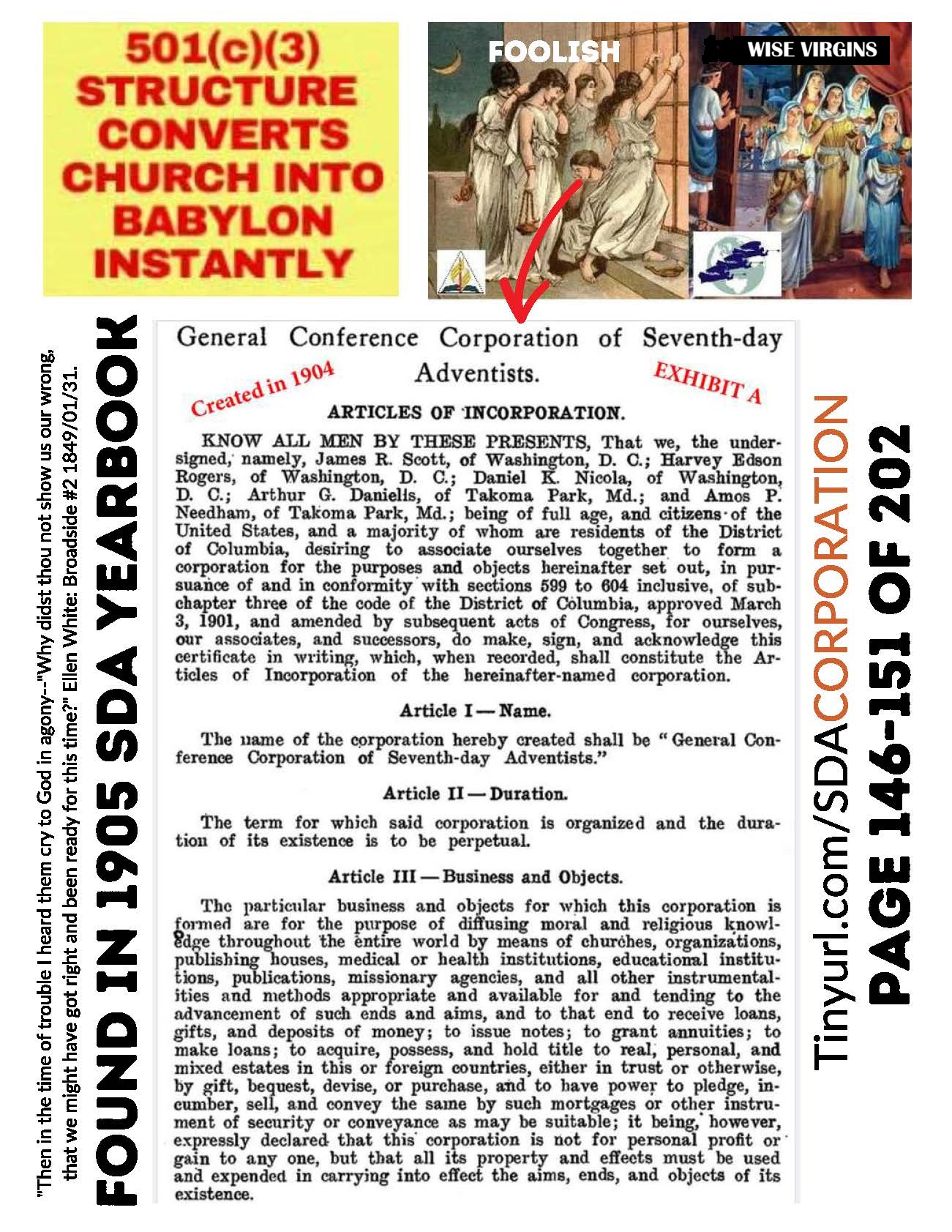
1904 Articles of Incorporation — Page 1 (click to view PDF)
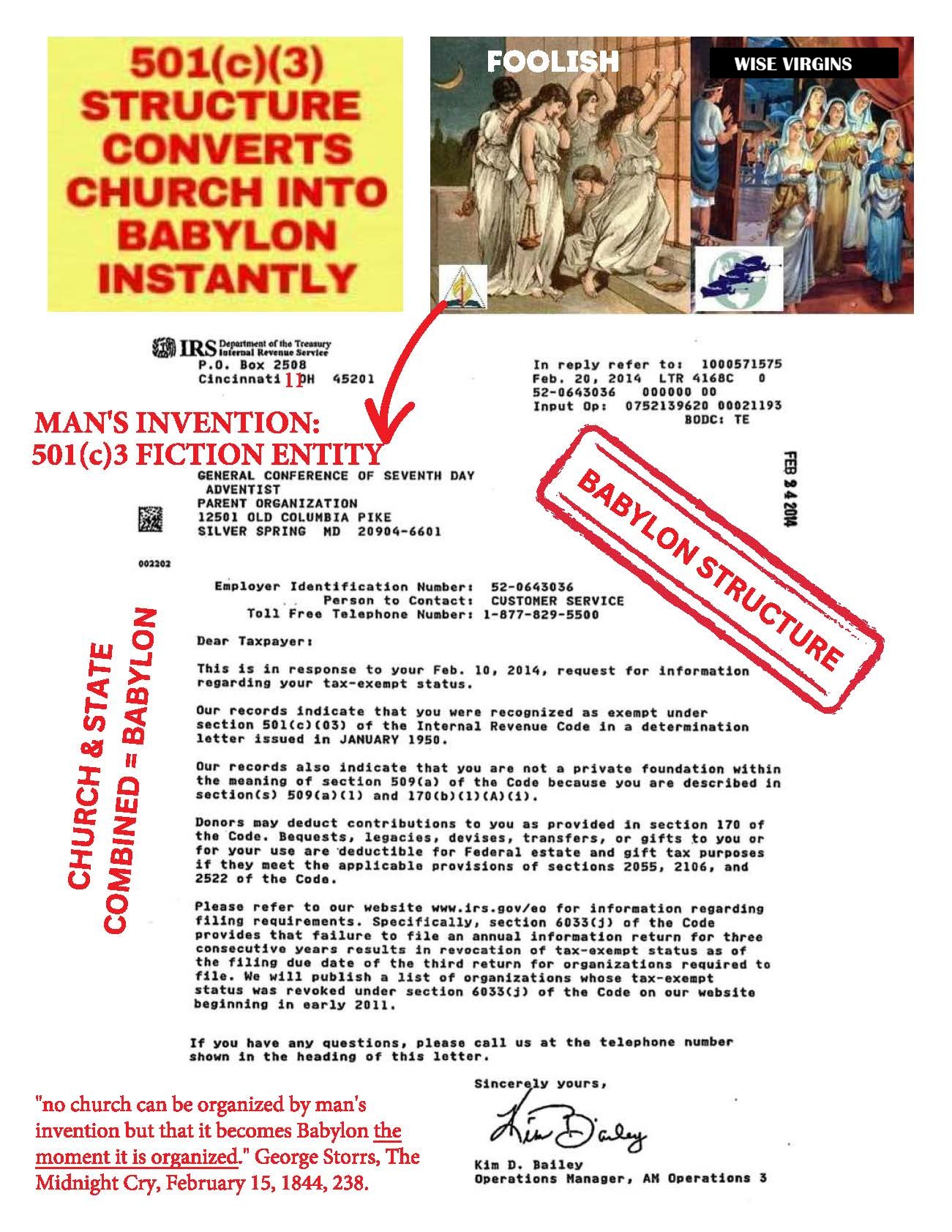
1904 Articles of Incorporation — Page 2 (click to view PDF)
The organization was legally registered as a corporation — a creature of civil law — giving it the legal form, protections, and obligations of a state-chartered entity. The church was now married to the State, fulfilling Ellen White's most solemn warnings.
"There is danger in our large cities... When the church shall so ally herself with the state as to seek the aid of the state, that moment she has apostatized from God." — Ellen G. White
The five signers of the 1904 Articles of Incorporation were: James R. Scott, Harvey Edson Rogers, Daniel K. Nicola, Arthur G. Daniells, and Amos P. Needham — all of whom affixed their names to a document that formally joined the Adventist church to the civil power of Washington, D.C.
The 1903 Planning — Premeditated from the Start
October 22, 1903 — Sixtieth Meeting: The Corporation Is Voted
The incorporation of April 15, 1904 was not a spontaneous decision. At the Sixtieth Meeting of the General Conference Committee, held in Washington, D.C. at 9:45 A.M. on October 22, 1903 — months before the formal filing — the committee voted to create the new D.C. corporation and named seven original incorporators. The following is the verbatim record:
"Inasmuch as the General Conference Association is a corporation of the State of Michigan, requiring that its meetings shall be held in that State, to great inconvenience, as the headquarters is now removed; and,--
"Inasmuch as the legal Foreign Mission Board is a corporation of New York, requiring its legal annual meetings to be held there; it is,--
"Voted, That the General Conference Committee be instructed to create a corporation under the laws of the District of Columbia, to transact the business heretofore attended to by the Foreign Mission Board and the General Conference Association; and,--
"Voted, That the Foreign Mission Board be wound up and its assets transferred to the new corporation; and further,--
"Voted, That so far as possible to arrange, the new corporation shall give its notes to replace the notes of the Gen. Conf. Ass'n., and that when the Michigan corporation lapses, its affairs be wound up.
*"Voted, That the incorporators be the following, and that they be instructed to elect themselves a Board to hold over until the next General Conference: A.G.Daniells, W.A.Spicer, W.T.Bland, W.W.Prescott, S.N.Curtiss, J.S.Washburn, A.P.Needham."*
"Voted, That we request the General Conference Association of Michigan and the Foreign Mission Board of New York as rapidly as possible to transfer all of their assets and liabilities to the new corporation."
— Sixtieth Meeting, General Conference Committee, Washington D.C., October 22, 1903
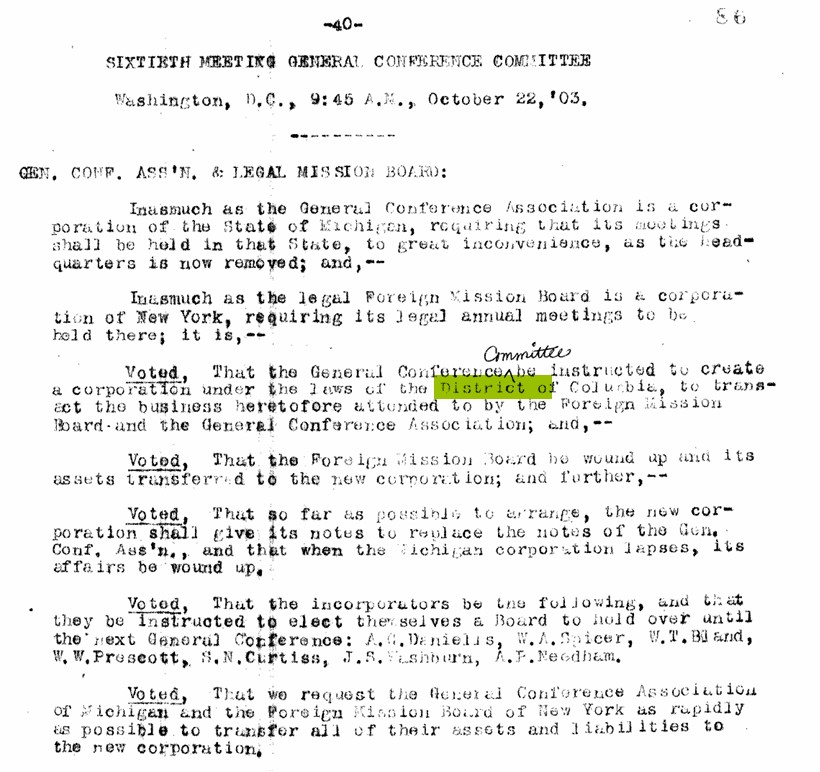
Sixtieth Meeting, GC Committee — October 22, 1903 — seven original incorporators voted (click to enlarge)
The original seven incorporators named on October 22, 1903:
- A.G. Daniells
- W.A. Spicer
- W.T. Bland
- W.W. Prescott
- S.N. Curtiss
- J.S. Washburn
- A.P. Needham
Note the stated reason for the new D.C. corporation: the existing General Conference Association was incorporated in Michigan — requiring its meetings there — and the Foreign Mission Board was in New York — requiring its meetings there. With the GC headquarters now in Washington D.C., both were inconvenient. The solution: dissolve both into one new D.C. corporation. This was a legal and administrative restructuring — not a spiritual calling.
April 13, 1904 — Five of Seven Replaced for D.C. Residency
By April 1904, five of the seven original nominees were no longer District of Columbia residents, disqualifying them under D.C. law. The October 22, 1903 vote was formally reconsidered.
Of the original seven, only two survived into the final signer list:
- ✓ A.G. Daniells — remained (D.C. resident as GC President)
- ✓ A.P. Needham — remained (D.C. resident)
Five were dropped — W.A. Spicer, W.T. Bland, W.W. Prescott, S.N. Curtiss, J.S. Washburn — and replaced by three new D.C.-resident men: J.R. Scott, H.E. Rogers, and D.K. Nicola.
Notably, several of the dropped nominees — Spicer, Prescott, Bland, Washburn — were present in the room at the April 13 meeting when the vote reconsidering their own appointment was made.
Who was present at the April 13–14, 1904 reconsidering meeting: Core committee members: A.G. Daniells, W.W. Prescott, H.W. Cottrell, F. Griggs, W.A. Spicer By invitation: Allen Moon, W.T. Bland, A.P. Needham, J.S. Washburn, J.R. Scott, J.N. Nelson
"Attention was called to the fact that the majority of those named as incorporators at the October meeting of the Committee are not now residents of the District of Columbia, as required by law."
"VOTED, That the action of the Committee in its meeting of October 22, 1903, naming the incorporators of the new legal association of the General Conference, be reconsidered."
"VOTED, That inasmuch as the majority of the persons named in the action of October 22, 1903 are not now resident in the District of Columbia, we appoint A.G. Daniells, J.R. Scott, A.P. Needham, H.E. Rogers, D.K. Nicola as incorporators of the General Conference Corporation of Seventh-day Adventists."
"VOTED, That the draft of articles of the General Conference Corporation of Seventh-day Adventists be approved as amended, and that the incorporators be recommended to file the same."
— GC Committee Minutes, April 13, 1904 — signed A.G. Daniells, Chairman; W.A. Spicer, Secretary
This appointment was based on legal necessity, not spiritual office. The final five signers were selected entirely because they were D.C. residents who could lawfully execute the filing.
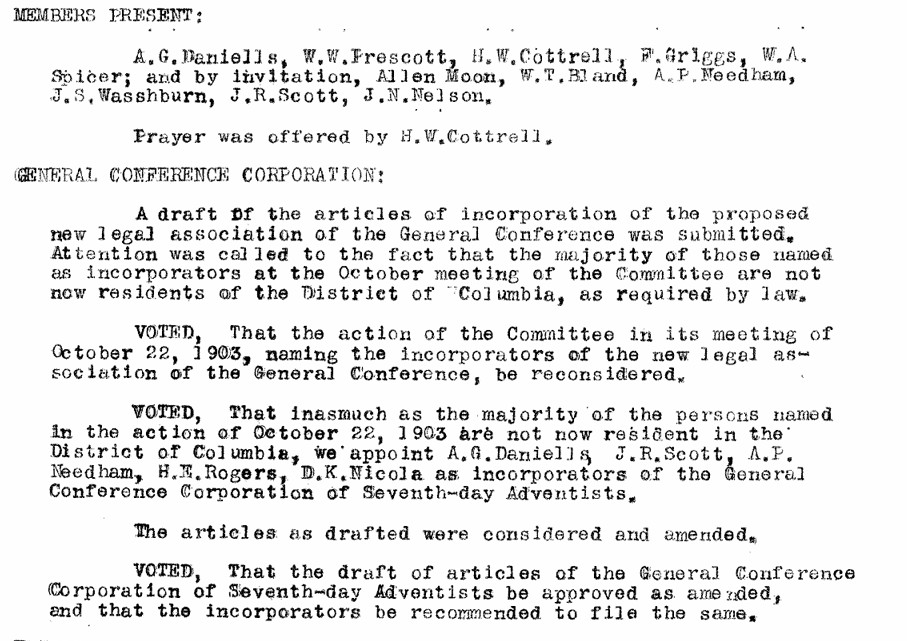
GC Committee Minority Meeting, April 13, 1904 — five of original seven replaced for D.C. residency (click to enlarge)
The Evidence: 1905 Yearbook
The 1905 Seventh-day Adventist Yearbook documents the new corporate structure beginning on page 139. This is the primary historical evidence — in the church's own published record — of what was done.
The yearbook records the new corporate name, the registered address in Washington D.C., the officers who signed the incorporation, the new legal structure (board of directors, trustees, bylaws), and the first annual meeting under the new corporate framework. This is not speculation. It is in the church's own yearbook.
The Warnings He Refused
Ellen White sent warning after warning to the leadership — including Daniells personally. Every warning was refused. The Spirit was quenched.
Warning 1 — Letter 242, October 1903
"There is a very decided objection on the part of some of our brethren to receiving the testimonies of the Holy Spirit. The leaders of the people are leading them away from the the old landmarks. They are becoming popular with the world, and the Spirit of God is departing from them."
— Ellen G. White, Letter 242, October 1903
This letter was written seven months before the April 15, 1904 incorporation. Daniells received it. He proceeded anyway.
Warning 2 — Selected Messages Vol. 1, p. 204
"We are not to bind up with legislative councils, with the laws of the land, for this is to put ourselves in the position of Babylon... to have ecclesiastical councils binding us to civil law — this is the mark of the beast."
— Ellen G. White, 1SM 204
Warning 3 — Sand Foundation Warning
"The church is in the Laodicean state. The presence of God is not in her midst... A wrong foundation has been laid. Methods have been adopted that God has not sanctioned."
— Ellen G. White, Testimonies to Ministers, p. 489
Warning 4 — Testimonies to Ministers, p. 493
"Let no man feel at liberty to plead that he has authority from God to assume the control and oversight of his fellow men... The church is not to be controlled by men."
— Ellen G. White, TM 493
Warning 5 — 1901 General Conference Address
"God is not pleased with the arrangement. The General Conference is no longer the voice of God."
— Ellen G. White, 1901 General Conference Address
Daniells was present at the 1901 GC when these words were spoken aloud. Three years later, he presided over the very act that fulfilled every fear the Prophetess had expressed.
Image of the Papacy — Rev 13:11–18
The Book of Revelation speaks of a second beast — one that looks like a lamb but speaks as a dragon — that causes the earth to "make an image" to the first beast. The Adventist pioneers understood this prophecy clearly.
"And he had power to give life unto the image of the beast, that the image of the beast should both speak, and cause that as many as would not worship the image of the beast should be killed." — Revelation 13:15
What is the Image of the Beast?
"When the leading churches of the United States, uniting upon such points of doctrine as are held by them in common, shall influence the State to enforce their decrees and to sustain their institutions, then Protestant America will have formed an image of the Roman hierarchy, and the infliction of civil penalties upon dissenters will inevitably result."
— Ellen G. White, The Great Controversy, p. 445
An image is a replica. The Papacy is a union of church and state — a religious organization that holds civil charter and power. When Daniells incorporated the General Conference under the civil laws of the District of Columbia, he created an image — a structural replica — of exactly that system.
The Papacy = a church that holds civil power and charter.
The 1904 SDA Corporation = a church registered under civil charter.
The image is complete.
See the complete prophetic analysis on the April 15, 1904 — New Organization page.
Daniel 2: Clay and Iron
The great image of Daniel 2 ends with feet of iron mixed with clay — the co-mingling of civil power (iron = Rome) and ecclesiastical power (clay = the people of God). The Adventist pioneers taught that this mixture would be the final apostasy.
"And whereas thou sawest iron mixed with miry clay, they shall mingle themselves with the seed of men: but they shall not cleave one to another, even as iron is not mixed with clay." — Daniel 2:43
Ellen White wrote:
"The mingling of churchcraft and statecraft is represented by the iron and the clay in the feet of the image. This union is weakening all the power of the churches."
— Ellen G. White, Review and Herald, August 11, 1903
April 15, 1904 is exactly this. A religious organization — the General Conference Corporation of Seventh-day Adventists — formally registered as a civil organization in Washington, D.C. Clay and iron. Church and state. Mixed in the seat of American civil government.
The Mayflower vs. District of Columbia
In 1620, the Pilgrims boarded the Mayflower and sailed from England to Plymouth Rock. They were fleeing the Church of England — a state church — a union of religious and civil authority that dictated faith, punished dissent, and used the power of the Crown to enforce church doctrine.
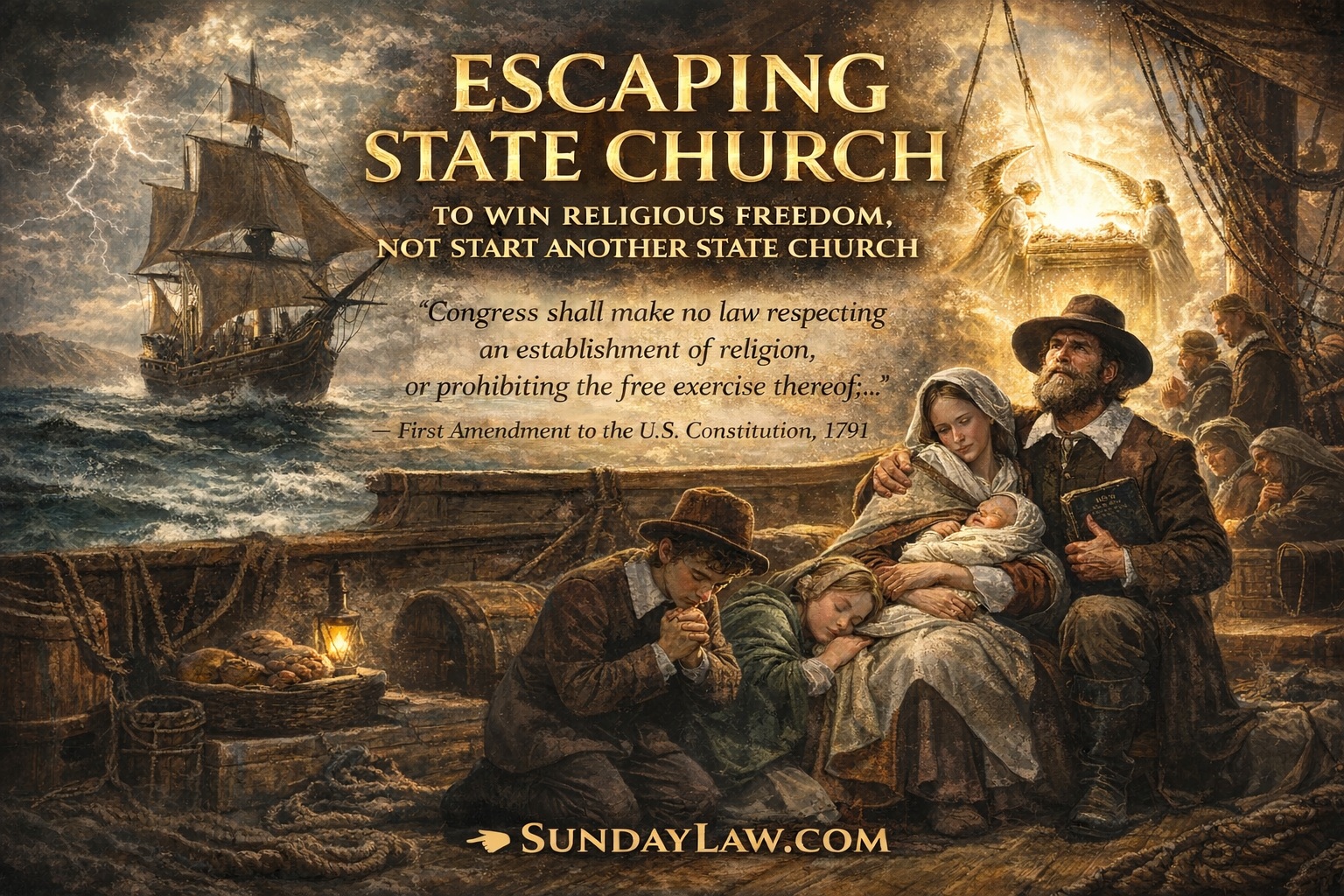
The Mayflower, 1620 — God's people fled England to escape the union of church and state
284 years later, in Washington, D.C., Arthur Grosvenor Daniells took the General Conference Corporation of Seventh-day Adventists and bound it to the civil government of the United States — registering it as a civil corporation in the nation's capital. He recreated — on American soil, in the seat of American government — the very structure the Pilgrims crossed an ocean to escape.
The Pilgrims fled a state church. Daniells built one.
James White — one of the three founders of the Seventh-day Adventist Church — understood this danger clearly:
"It is not our mission to seek political power. The moment the church seeks the arm of civil power, that moment she has made an image to the beast — and the deadly work has begun."
— James White, Review and Herald, 1877
The Mayflower brought God's people to a land of religious freedom. April 15, 1904 was the day that freedom was surrendered.
The 1850 Prophetic Chart
The 1850 Prophetic Chart — prepared under the direct guidance of the Holy Spirit, through the work of Otis Nichols — charts every major prophetic symbol from Daniel and Revelation, including the Image of the Beast and the final conflict between the remnant and Babylon. The pioneers who prepared this chart understood that what Revelation 13 described would one day be fulfilled on American soil.
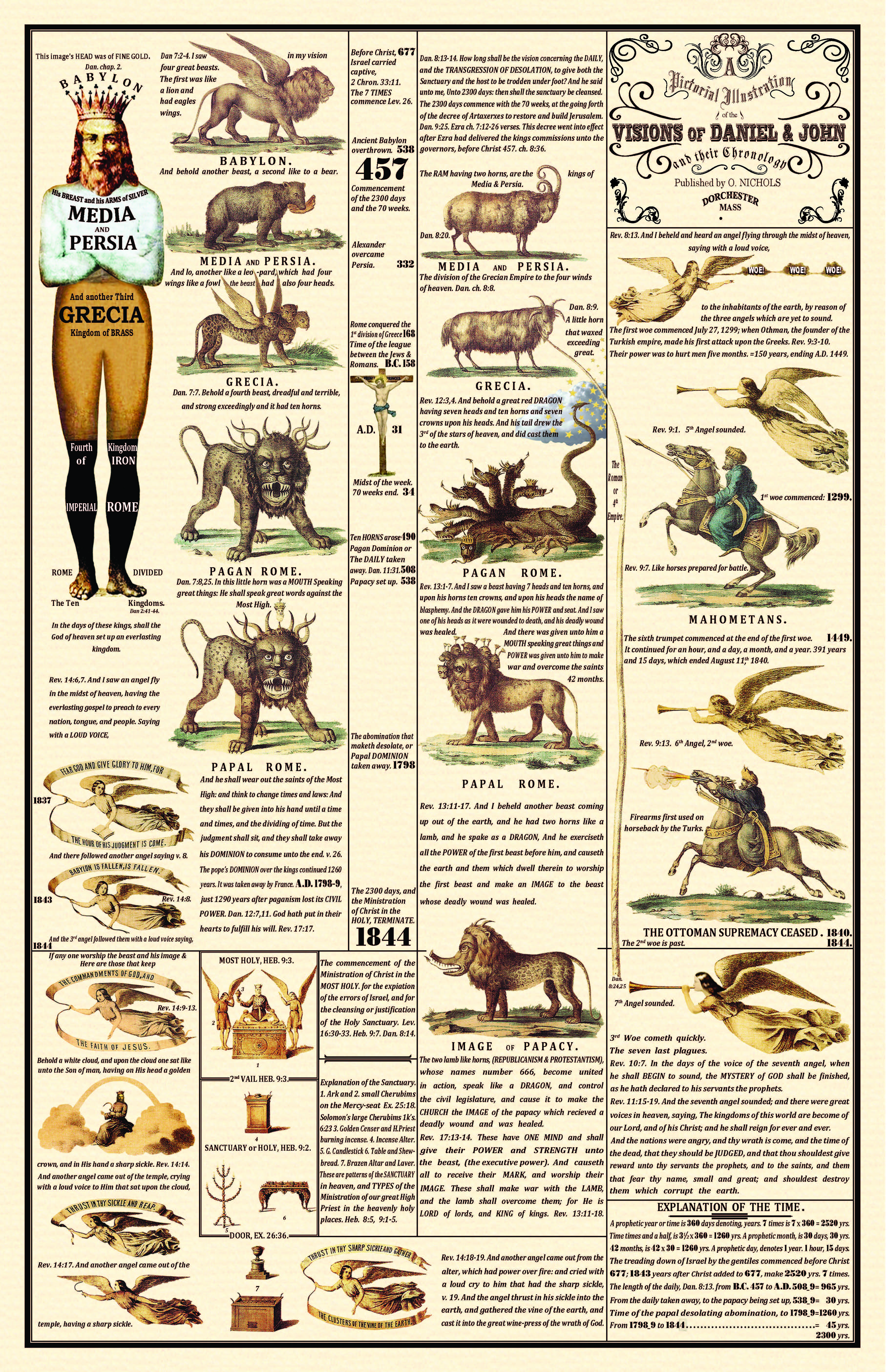
The 1850 Prophetic Chart — prepared under Ellen White's direction by Otis Nichols (click to view)
That chart showed what April 15, 1904 would one day fulfill — the Image of the Papacy rising inside the Adventist organization itself.
The Indictment
The historical record against Arthur Grosvenor Daniells is not a matter of opinion. It is documented in the church's own publications, confirmed by Ellen White's personal correspondence, and provable in American legal records. The following is a seven-count indictment of what was done.
Count 1 — Apostasy from Foundational Doctrine
The Seventh-day Adventist movement was founded explicitly on the principle that church and state must remain separate — that civil law must never govern spiritual bodies. Daniells violated this foundation by design.
Count 2 — Defiance of the Prophetic Voice
Ellen White sent documented, specific, personal warnings against creating an ecclesiastical-civil union. Daniells received them — and proceeded six months later.
Count 3 — Creating the Image of the Papacy
By binding the church to civil law under the District of Columbia, Daniells created exactly the "image" of Rome that Revelation 13 and Ellen White's Great Controversy describe. The structure was not incidental. It was deliberate institutional design.
Count 4 — Identity Theft (Idem Sonans Doctrine)
The corporation was registered under the name "General Conference Corporation of Seventh-day Adventists" — claiming the identity, property, and historical authority of the true spiritual body. The legal doctrine of idem sonans describes a name that sounds the same but belongs to a different legal entity. The corporation is not the church. It is an image of it.
Count 5 — First Amendment Compromise
By incorporating as a civil organization, the leadership subjected the church to civil jurisdiction — entangling it with state interests, tax law, and regulatory authority in ways that compromise the independence that the First Amendment protects.
Count 6 — Silencing the Truth-Bearers
Following 1904, those who held to the original platform — the old landmarks — were systematically marginalized, removed from positions of influence, or silenced within the denomination. The organization was used against the remnant.
Count 7 — The Pattern of Korah
Scripture records the judgment on those who presume to take authority not delegated to them (Numbers 16). Self-assumed ecclesiastical authority that defies the LORD's appointed messengers carries a documented biblical precedent. The pattern is established.
Pioneer Voices
The founders and pioneers of the Advent movement were clear on what the 1904 act would mean. These words were written before April 15, 1904 — they are prophetic of exactly what Daniells did.
John Norton Loughborough — Five Steps of Apostasy
Elder Loughborough, who personally witnessed the founding of the Adventist movement, published the Five Steps of Apostasy in the Review and Herald, October 8, 1861 — forty-three years before Daniells signed the incorporation:
- Get up a creed, telling us what we shall believe
- Make that creed a test of fellowship
- Try members by that creed
- Denounce as heretics those who do not believe that creed
- Commence persecution against such
"The first step of apostasy is to get up a creed, telling us what we shall believe… the second is to make that creed a test of fellowship; the third is to try members by that creed; the fourth to denounce as heretics those who do not believe that creed; and fifth, to commence persecution against such."
— John N. Loughborough, Review & Herald, October 8, 1861
All five steps were fulfilled by the 1904 corporate structure. The incorporation imposed a legal creed enforceable by civil courts; membership in the corporation became the test of fellowship; those outside it were excluded from the name and platform; non-corporate Adventists were labeled independent or fanatical; and the corporate body used trademark law in civil courts to prevent anyone outside the corporation from using the name the pioneers chose in 1860 — and never registered with any government.
James White — The Danger of Civil Organization (1877)
"It is not our mission to seek political power. The moment the church seeks the arm of civil power, that moment she has made an image to the beast — and the deadly work has begun."
— James White, Review and Herald, 1877
Alonzo T. Jones — Two Republics (1891)
"The union of church and state has always been and always must be the enemy of religious liberty and of truth. It is the very definition of the Papacy — and when America forms this union, she speaks as a dragon."
— A.T. Jones, The Two Republics, 1891
These men laid the foundation. Daniells broke it. And many souls have been lost because the organization that should have been the last warning voice before Christ's return became instead an image of the very Babylon it was called to call people out of.
For the complete evidence: April 15, 1904 — The New Organization · 1904 Signers — Daniells · 1850 Prophetic Chart