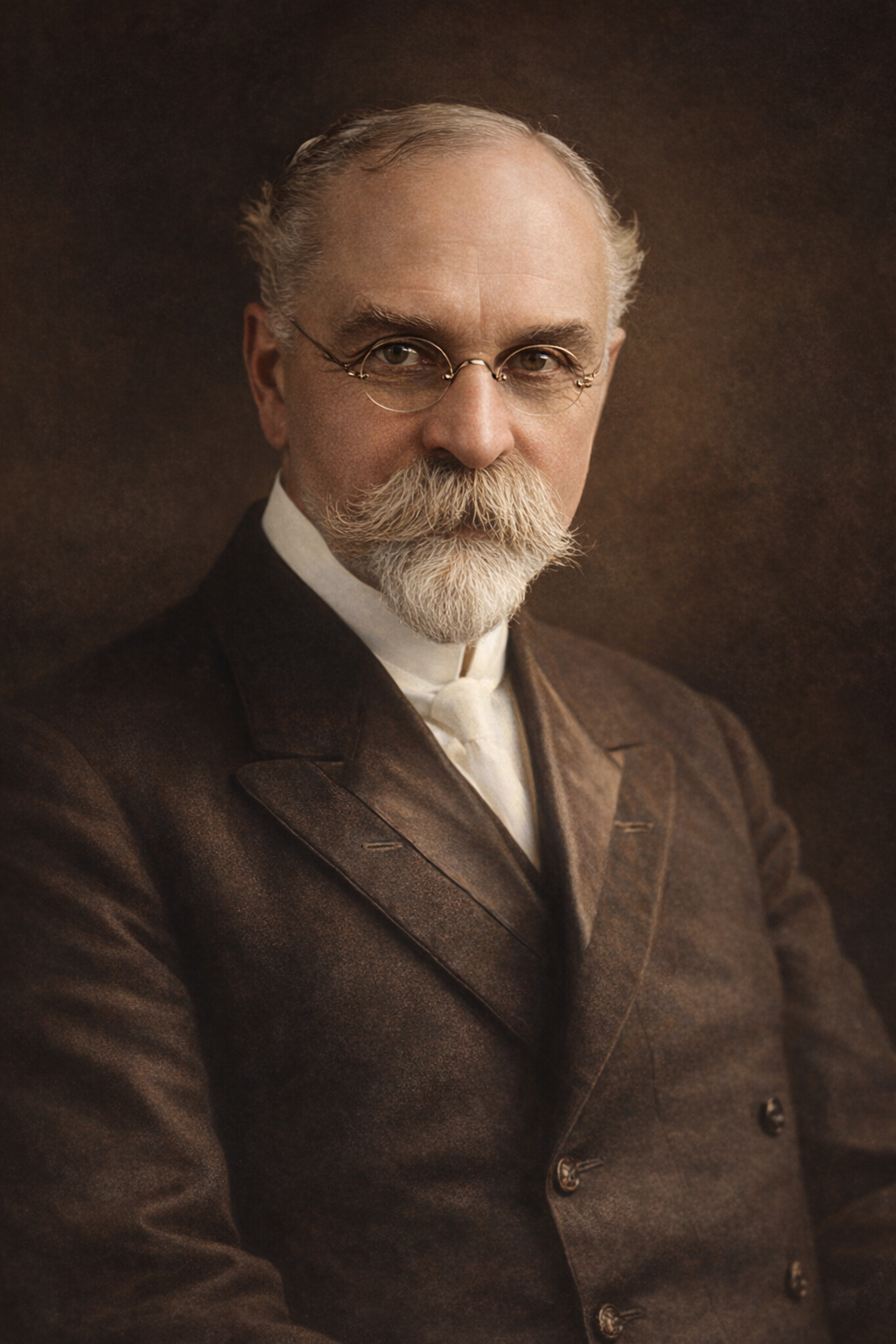
Arthur Grosvenor Daniells —
The President Who Signed Away the Church
Arthur G. Daniells was the General Conference President of the Seventh-day Adventist denomination at the time of the April 15, 1904 incorporation. As the highest authority in the organization, he did not merely witness or endorse the signing — he orchestrated it. His name appears first among the Takoma Park signatories. He had read Ellen White's Letter 242 (October 1903). He had heard her warnings against centralization. He signed anyway.
What Arthur G. Daniells Did
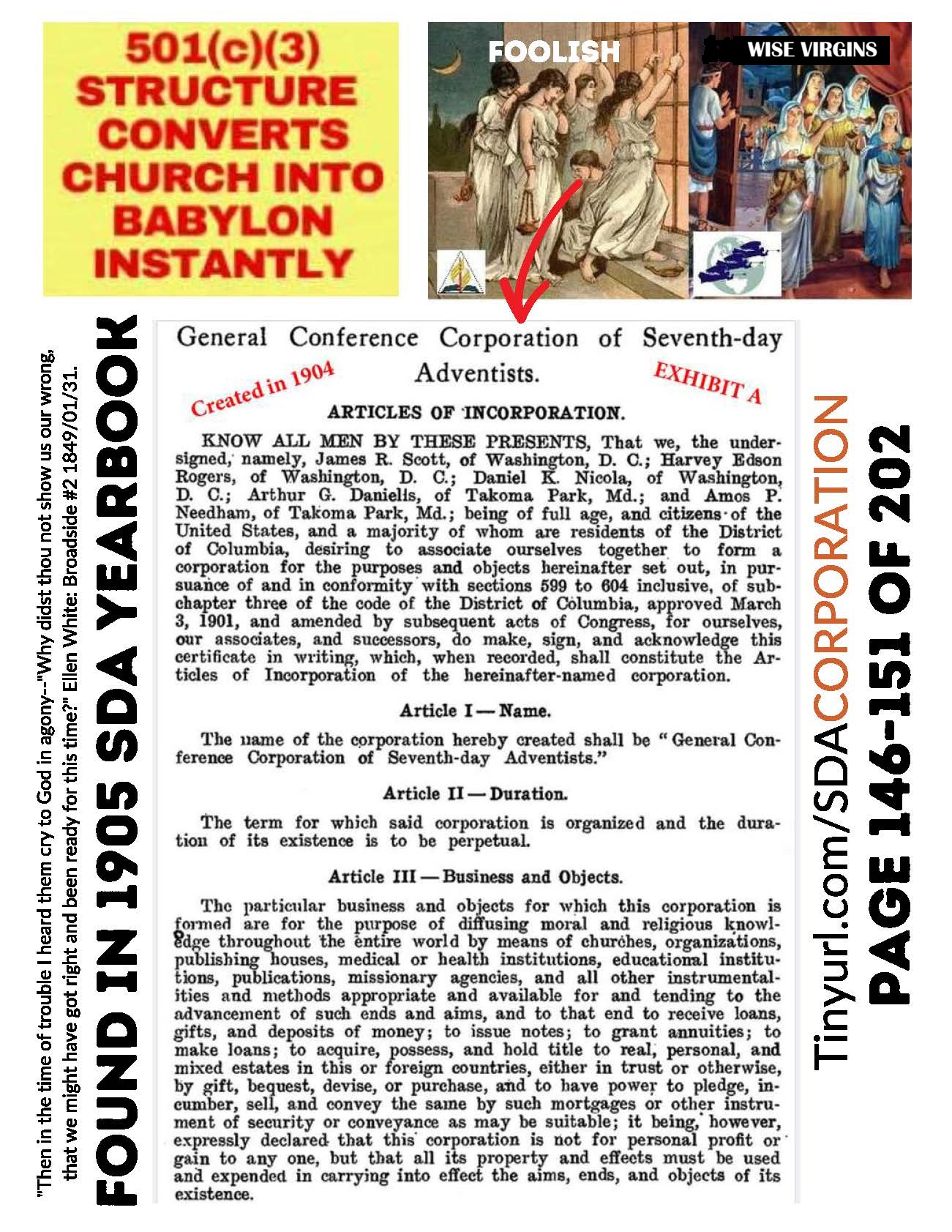
On April 15, 1904, Arthur G. Daniells — serving as the elected president of the General Conference of Seventh-day Adventists — oversaw and signed the incorporation of the “General Conference Corporation of Seventh-day Adventists” as a civil legal entity in the District of Columbia, under the laws of the federal government of the "UNITED STATES."
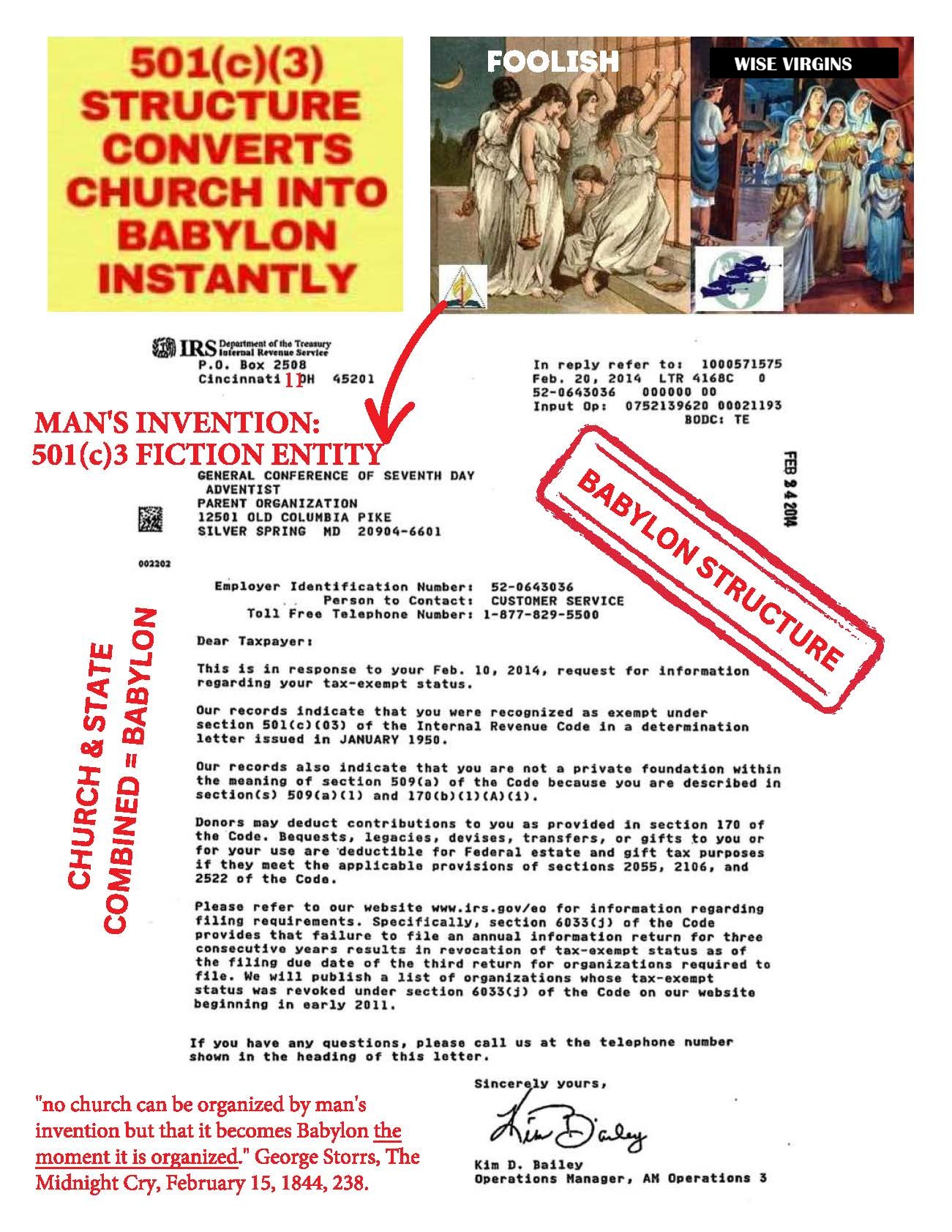
This act created what Ellen White had explicitly warned against in October 1903: "a new organization." It placed the Seventh-day Adventist movement under the legal authority and oversight of a civil government — registering the church's governance, property, and institutional authority as subject to the laws of Caesar.
This is precisely the definition of the Image of the Papacy as described by the 1850 Prophetic Chart: a religious body that uses civil power to enforce its decrees. Rome did this. Now, in April 1904, Adventism did this in the very city designed after Rome.
What Ellen White Told Him
Ellen White's warnings to the General Conference leadership — including specific correspondence directed at Daniells as president — were unambiguous. These warnings were given before the signing. Daniells was not ignorant. He was defiant.
“We have our Bibles. We have our experience, attesting to the truth of God's word, and we cannot now enter into any new organization, for this would mean apostasy from the truth.”— Ellen G. White, 1SM 204 (Letter 242, October 1903)
“The enemy of souls has sought to bring in the supposition that a great reformation was to take place among Seventh-day Adventists, and that this reformation would consist in giving up the doctrines which stand as the pillars of our faith… The principles of truth that God in His wisdom has given to the remnant church, would be discarded.”— Ellen G. White, 1SM 204 (Letter 242, October 1903)
“Their foundation would be built on the sand, and storm and tempest would sweep away the structure.”— Ellen G. White, 1SM 204 (Letter 242, October 1903) — Describing what Daniells built on April 15, 1904
“God has not called any one man, or set of men, to be the repository of all truth, or to be entrusted with the concentration of power over the flock of Christ. The spirit of domination must not be allowed to develop. The men who lead the work must let the Spirit of God do the directing, not lay their plans and pursue them by their own authority.”— Ellen G. White, Testimonies to Ministers, p. 493
“The work is so large and has extended to such dimensions that the power of one man or a few men to control it is not only unwise but positively dangerous. Study how God organized Israel… I am instructed to say that God's delegated, representative authority is being ignored by men who presume to exalt themselves.”— Ellen G. White, Address at the 1901 General Conference Session, April 1901
The Charges Against Arthur G. Daniells
This is not a legal court. This is the court of Heaven's record and the testimony of the prophets. The following charges stand against Arthur G. Daniells on the basis of the Scriptures, the Spirit of Prophecy, and the historical evidence.
- IApostasy against the Original Pioneer Platform. As GC President, he led the denomination away from the divine structure established by God's own direction through the pioneering work of 1841–1850 — unincorporated, Spirit-directed, and free from civil entanglement.
- IIDefiant rejection of a direct prophetic warning. Ellen White's Letter 242 (October 1903) was delivered six months before the April 15, 1904 signing. Daniells, as GC President, was the intended recipient of that warning. He read it. He signed anyway.
- IIICreating the Image of the Papacy. By incorporating the church under civil law, Daniells joined the religious body to the civil state — the very definition of the "Image of the Papacy" as described in Revelation 13 and on the 1850 Prophetic Chart. The union of church and state, warned against by every Adventist pioneer, was consummated under his signature.
- IVIdentity theft of the pioneer name "Seventh-day Adventist." Under the Idem Sonans doctrine, the 1904 corporate name "General Conference Corporation of Seventh-day Adventists" was designed to sound identical to the free spiritual name chosen by the pioneers in 1860. Daniells used the similarity to claim the legacy, libraries, and credibility of the pioneer movement for a corporate body that stood in opposition to it.
- VViolation of the First Amendment principle of church-state separation. By voluntarily incorporating under the laws of the District of Columbia — the federal "UNITED STATES" jurisdictional entity — Daniells placed the church under Caesar's oversight. The First Amendment protected Adventists' right to worship without government control. He voluntarily surrendered that protection.
- VISilencing and persecuting truth-bearers. The incorporation gave the corporate body legal tools — trademark law, copyright enforcement, institutional disfellowship — to suppress and punish those who continued proclaiming the original Three Angels' Messages. Daniells' structure began fulfilling Loughborough's Fifth Step of Apostasy: "commence persecution against such."
- VIIThe Korah Rebellion Pattern. Ellen White compared the 1904 new organization to the rebellion of Korah, Dathan, and Abiram — men who, under the form of piety, challenged God's appointed structure and set up their own rival authority. Daniells, like Korah, wore a priestly garment while building an altar to self-governance.
The Pioneers Prophesied What Daniells Would Do
“The first step of apostasy is to get up a creed, telling us what we shall believe… the second is to make that creed a test of fellowship; the third is to try members by that creed; the fourth to denounce as heretics those who do not believe that creed; and fifth, to commence persecution against such.”
— John N. Loughborough, Review & Herald, October 8, 1861 — Loughborough founded the church with James White. He described Daniells' 1904 path 43 years before Daniells walked it.“Making a creed is setting the stakes, and driving them firmly, after which there is no moving… Instead of this, let the living, free Spirit of God guide His people in the old paths.”
— James White, 1848 — James White refused any organization that placed human or civil authority over the free movement of God's Spirit. Daniells reversed this in 1904.“The making of laws in the religious domain, and the enforcement of them by civil power, is what Protestants once called POPERY.”
— James White, Review & Herald, 1877 — April 15, 1904 is when Adventism became what James White spent his life opposing.“The union of church and state is the masterpiece of Satan. When a church body submits to civil incorporation, it prostrates itself before the very power it was called to reform.”
— Alonzo T. Jones, The Two Republics, 1891 — The man who had sat in the U.S. Senate hearings arguing against the National Sunday Law described exactly what Daniells signed into existence in 1904.How Daniells Stole the Pioneer Name
The original name "Seventh-day Adventist" was chosen in 1860 by the founding pioneers as a free spiritual identity. It was never trademarked, never incorporated, never registered with any government. It was a people's prophetic name — belonging to everyone who kept the Commandments of God and had the Faith of Jesus (Rev. 14:12).
Arthur Daniells' 1904 corporate filing used the name "General Conference Corporation of Seventh-day Adventists" — deliberately engineered to echo the pioneer name "Seventh-day Adventist." Under the legal doctrine of Idem Sonans (“sounding the same”), two names that sound nearly identical are treated as the same entity in legal proceedings.
This is how the 1904 corporate entity stole the identity, legacy, and writings of the pioneer movement. A church member hearing "Seventh-day Adventist Church" and "General Conference Corporation of Seventh-day Adventists" would assume they were the same body. The law agrees. Spiritually and historically, they are not the same body.
The 1904 corporation has since trademarked the name "Seventh-day Adventist" and used the civil courts — the very courts the Name was incorporated into — to prevent non-corporate Adventists from using their own pioneers' name. This is the boot on the neck. This is Daniells' legacy.
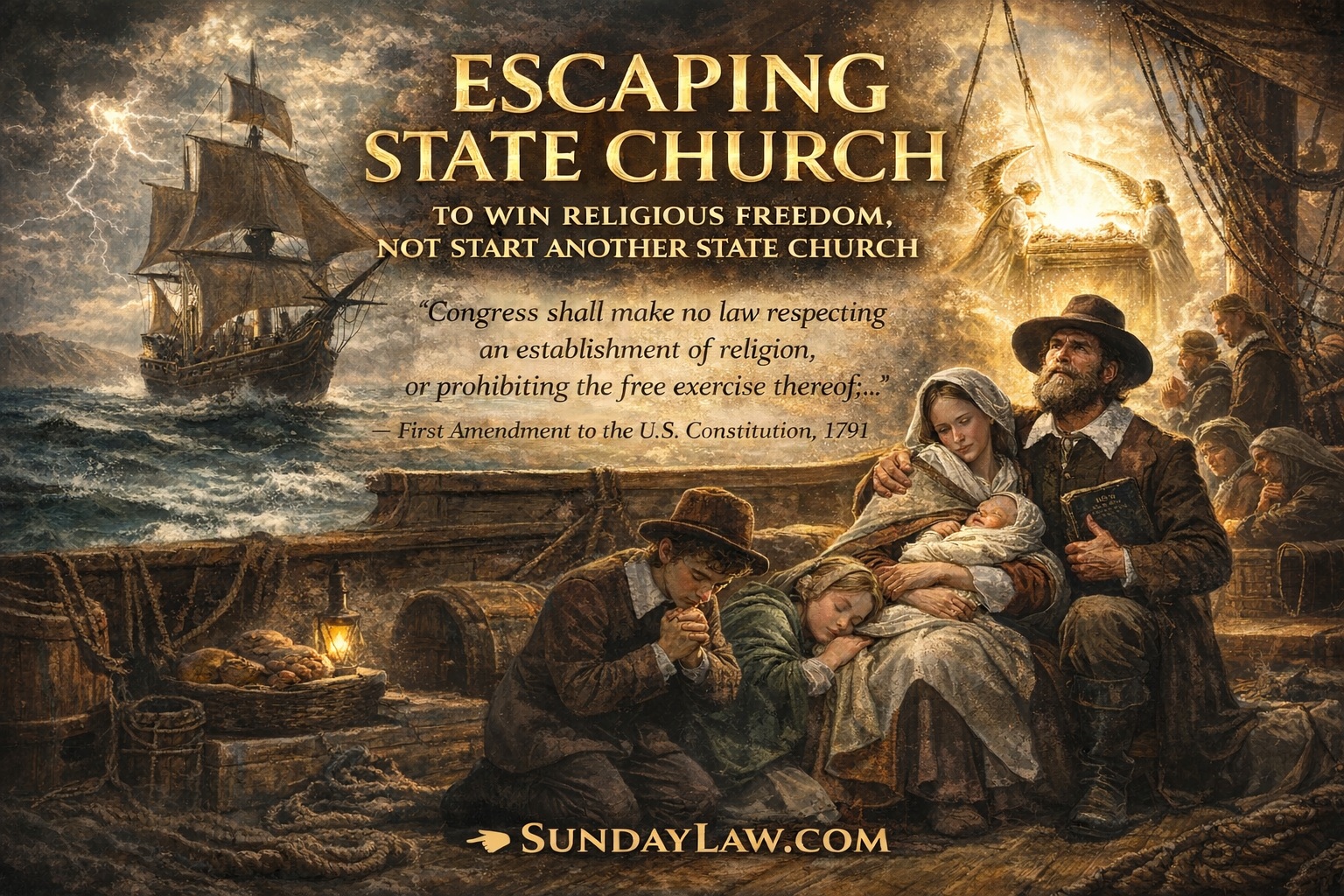
Wikipedia: Idem Sonans → • The Law Dictionary → • US Legal Forms →“Congress shall make no law respecting an establishment of religion, or prohibiting the free exercise thereof…”— First Amendment, Bill of Rights, U.S. Constitution, December 15, 1791
The First Amendment was designed by men who feared exactly what Daniells created. By voluntarily incorporating under civil law, Daniells placed the church under government oversight — submitting GC governance to the laws of the "UNITED STATES" corporate entity in the District of Columbia. The government now had legal authority over the church's organizational structure, property, and institutional behavior. The First Amendment protected Adventists from government control of religion. Daniells voluntarily waived that protection on April 15, 1904.
Official Source: constitution.congress.gov →The Mayflower vs. The District of Columbia
In 1620, the Pilgrims crossed the Atlantic in the Mayflower, fleeing the Church of England's persecuting power — a state church that used civil law to fine, imprison, and silence those who refused to worship according to its decrees. They came to America and established the principle that would become the First Amendment: Congress shall make no law respecting an establishment of religion.
In 1904, in Washington, District of Columbia — a city modeled explicitly after Rome, with its domed Capitol echoing the Pantheon and its obelisk mirroring the Vatican — Arthur G. Daniells signed the identical structure back into existence. The church-state union the Pilgrims crossed an ocean to escape, Daniells walked across a street to create.
The Adventist pioneers themselves fled Babylon. They left their churches in 1843–1844 when those churches rejected the First Angel's Message. They founded a free movement on the original 1841–1850 platform. They chose a name — "Seventh-day Adventist" — that belonged to no government. Arthur G. Daniells, in a single morning in April 1904, undid sixty years of prophetic protest and handed the keys of the church to Caesar.
His Name in the 1905 Yearbook
The Articles of Incorporation signed by Daniells and the other four were officially published and confirmed in the 1905 Seventh-day Adventist Yearbook (pages 135–149). The document confirms: "this fifteenth day of April, A.D. 1904" and lists all five signatories, with their locations in either Takoma Park, Maryland, or Washington, D.C.