
James R. Scott (1820–1895)
James R. Scott stands as pioneering Adventist evangelist whose integration of temperance advocacy with revival preaching demonstrated Adventism's social reform commitments. His seventy-five years witnessed Adventist participation in nineteenth-century reform while maintaining prophetic focus.
Early Life & Reform Commitment
Massachusetts Childhood:
- Born Massachusetts, 1820
- Raised in reform-minded household
- Shown interest in social issues
- Developed temperance conviction
- Committed to moral reform
Reform Advocacy:
- Participated in temperance movement
- Advocated for social reform
- Demonstrated moral passion
- Worked for social change
- Believed reform essential
Spiritual Awakening & Ministry
Religious Conversion:
- Experienced spiritual awakening
- Committed to Christian faith
- Called to Christian ministry
- Licensed as minister
- Dedicated to spiritual service
Evangelistic Calling:
- Felt burden for spiritual conversion
- Conducted revival meetings
- Preached Gospel message
- Called for spiritual commitment
- Demonstrated spiritual effectiveness
Conversion to Adventist Faith
Encounter with Advent Message:
- Studied Seventh-day Adventist teaching
- Became convinced of Sabbath truth
- Embraced prophetic message
- Dedicated ministry to Advent proclamation
- Remained faithful to conviction
Integrated Vision:
- Saw Adventism as comprehensive reform
- Connected physical and spiritual
- Believed reform and prophecy interconnected
- Integrated social and spiritual concerns
- Modeled wholistic faith
Evangelistic & Reform Ministry
Revival Campaigns:
- Conducted revival meetings
- Preached prophetic message
- Called for spiritual commitment
- Established congregations
- Showed spiritual effectiveness
Temperance Advocacy:
- Continued temperance advocacy
- Integrated with spiritual message
- Showed faith affected lifestyle
- Called for total transformation
- Linked physical and spiritual reform
Wholistic Message:
- Preached comprehensive reform
- Addressed multiple issues
- Connected prophecy with reform
- Showed Adventism addressed all life
- Demonstrated integrated vision
Institutional Leadership
Conference Participation:
- Served in conference roles
- Participated in major decisions
- Influenced institutional policy
- Contributed leadership perspective
- Shaped organizational direction
Advocacy for Reform:
- Advocated for Adventist reform emphasis
- Influenced institutional priorities
- Shaped how denomination understood reform
- Advanced comprehensive approach
- Influenced missionary vision
Leadership Mentoring:
- Mentored younger ministers
- Shared evangelistic experience
- Taught integrated ministry
- Influenced next generation
- Transmitted institutional knowledge
Character & Impact
Prophetic Conscience:
- Maintained prophetic focus
- Kept spiritual message central
- Called believers to preparation
- Emphasized Advent imminence
- Oriented toward eternity
Reform Passion:
- Never abandoned social concerns
- Maintained temperance commitment
- Showed faith required ethical living
- Demonstrated moral courage
- Advocated for justice
Integrated Ministry:
- Showed spiritual and social inseparable
- Modeled wholistic faith
- Influenced others toward comprehensive vision
- Advanced Adventist understanding
- Created lasting impact
Legacy & Impact
Spiritual Foundation:
- Established congregations through revival
- Created faith communities
- Left pastoral legacy
- Influenced spiritual development
- Affected believers' lives
Reform Influence:
- Influenced Adventist social consciousness
- Shaped how Adventism understood reform
- Advanced comprehensiveness of faith
- Affected denominational priorities
- Influenced institutional policies
Ministerial Model:
- Demonstrated integrated ministry
- Showed spiritual-social connection
- Modeled wholistic faith
- Influenced ministerial understanding
- Advanced leadership development
Sources & Historical Record
James R. Scott appears in Adventist conference records and reform movement histories. His spiritual-reform ministry is documented. Historical sources acknowledge his contributions to Adventist evangelism and reform advocacy integration.
1904 Incorporator — Appointed for Legal Residency
October 22, 1903 — Scott Was Not on the Original List
At the Sixtieth Meeting of the General Conference Committee, Washington D.C., October 22, 1903, the committee voted to create the new D.C. corporation and named seven original incorporators. James R. Scott was not among them. The original seven were: A.G. Daniells, W.A. Spicer, W.T. Bland, W.W. Prescott, S.N. Curtiss, J.S. Washburn, and A.P. Needham.
"Voted, That the incorporators be the following, and that they be instructed to elect themselves a Board to hold over until the next General Conference: A.G.Daniells, W.A.Spicer, W.T.Bland, W.W.Prescott, S.N.Curtiss, J.S.Washburn, A.P.Needham."
— Sixtieth Meeting, General Conference Committee, Washington D.C., October 22, 1903
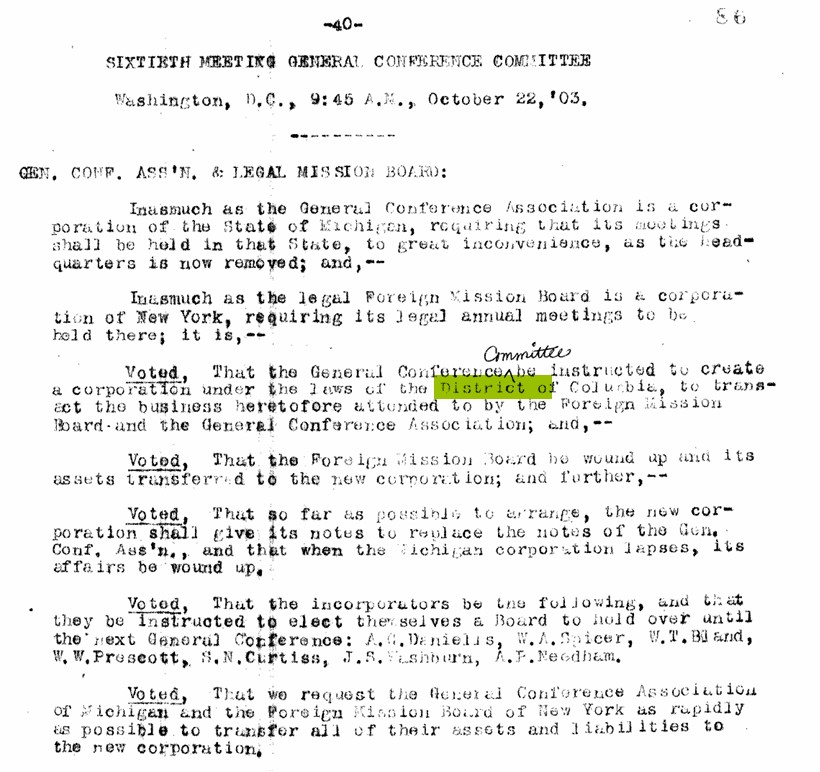
October 22, 1903 — Sixtieth Meeting, GC Committee — Scott is not in the original seven (click to enlarge)
April 13, 1904 — Scott Appointed as Replacement
By April 1904, five of those seven original nominees were no longer D.C. residents. The October 22, 1903 vote was reconsidered and Scott was brought in as one of three replacements specifically because he met the D.C. residency requirement.
James R. Scott was one of the five incorporators of the General Conference Corporation of Seventh-day Adventists, the civil corporation filed by A.G. Daniells on April 15, 1904 in Washington, D.C.
General Conference committee minutes from 1903 document that an earlier list of incorporators — voted at the October 22, 1903 committee meeting — had to be reconsidered because most of those named were not residents of the District of Columbia, as required by D.C. law. Daniells then appointed Scott along with four others who could meet the legal residency requirement.
"Attention was called to the fact that the majority of those named as incorporators at the October meeting of the Committee are not now residents of the District of Columbia, as required by law."
"VOTED, That inasmuch as the majority of the persons named in the action of October 22, 1903 are not now resident in the District of Columbia, we appoint A.G. Daniells, J.R. Scott, A.P. Needham, H.E. Rogers, D.K. Nicola as incorporators of the General Conference Corporation of Seventh-day Adventists."
— 1903 General Conference Committee Minutes
This appointment was based on legal necessity, not spiritual office. Scott was selected to satisfy a D.C. residency requirement for the incorporation filing — not because of prophetic calling or doctrinal leadership.
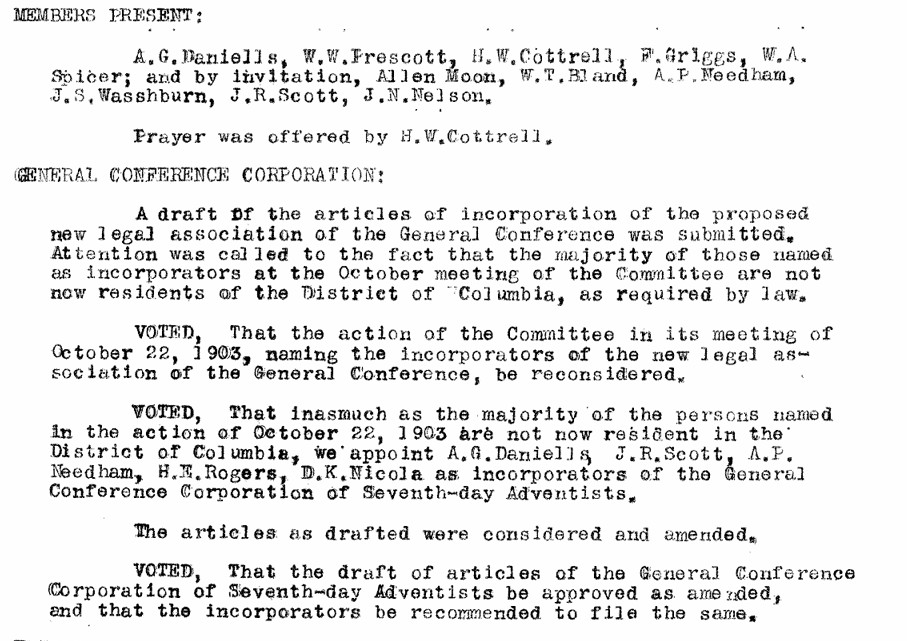
1903 GC Committee Minutes — incorporators selected for D.C. legal residency (click to enlarge)
See the full evidence: April 15, 1904 — The New Organization | Arthur G. Daniells
James R. Scott exemplifies the evangelist-reformer whose integration of prophetic message with temperance advocacy demonstrated Adventist commitment to comprehensive transformation.