Who Named the
Seventh-day Adventists?
More than a century and a half ago, on October 1, 1860, in Battle Creek, Michigan, 25 delegates gathered to answer a simple question: what should this movement call itself? The name was proposed by a man named David Hewitt — known across Battle Creek as "the most honest man" in the city. After lengthy discussion, the delegates voted 24 to 1 in favor. The movement of approximately 3,000 believers had a name: Seventh-day Adventist.
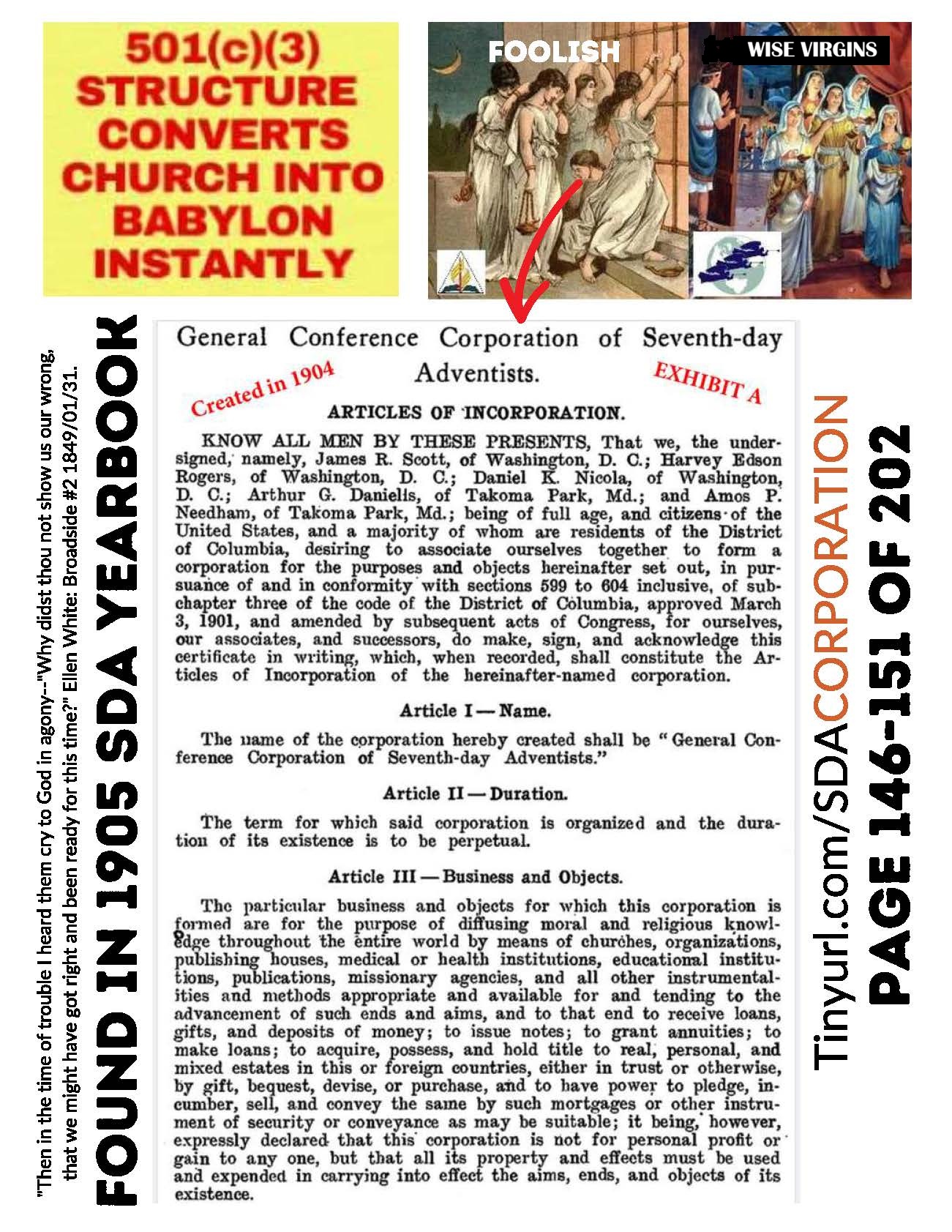
What followed over the next forty-four years is a story of institutional development that culminated in a document none of the pioneers anticipated: the Articles of Incorporation of the General Conference Corporation of Seventh-day Adventists, filed April 15, 1904 in Washington, D.C. — the incorporation of a free prophetic movement into a civil corporation of Caesar's own capital city. The primary source documents for every step of that story are on this page, free to read and download.
"I saw that they were in terrible conflict as to whether to take their stand for or against the light that God has permitted me to bear to the world. It seemed to me like a life-and-death question. I cannot describe it, but the conflict was a terrible one. The seductive presentations [trinity doctrine] framed by satanic agencies were presented by subtle reasoning, and their minds had well-nigh become overwhelmed when a heavenly messenger let light shine forth. There came to them the thought, Review the past experience of the people of God; review the history of the work from the first, as if you were beholding it in a mirror. Has this work been what it has been represented to you to be? Then another and still another scene was presented before them by the heavenly messenger, until they saw truth bearing the signature of the heavenly in the past, then present, and still more decidedly in the future. The words were spoken, "Strait is the gate, and narrow is the way, that leadeth unto life, and few there be that find it. Broad is the road and wide is the gate that leadeth to destruction, and many there be which go in thereat."—Manuscript Releases, vol. 13, p. 369.1 (Ellen G. White)
The Full Organizational Timeline — 1816 to 1904
From William Miller's first public proclamation to the five signatures on the Articles of Incorporation — every key organizational moment in its historical sequence.
William Miller Begins His Study
William Miller, a Baptist farmer in New York, begins his systematic study of Daniel 8:14 and the 2300-day prophecy. He calculates the cleansing of the sanctuary to occur "about 1843." His public preaching begins in 1831.
The Millerite Advent Movement
An estimated 50,000–100,000 believers across denominational lines follow the Advent message. This is not a new denomination — it is an interdenominational awakening calling God's people to readiness for the Second Coming. Charles Fitch preaches "Come Out of Her, My People" in 1843.
The Great Disappointment
Christ does not appear on October 22, 1844. The "shut door" group of Millerite believers receives the light of the heavenly sanctuary, the seventh-day Sabbath (through Joseph Bates), and the prophetic gift (through Ellen Harmon). A distinct remnant movement begins to take shape — intentionally without formal organization.
Sabbath Conferences — James White Resists Organization
A series of "Sabbath Conferences" across New England consolidates the doctrinal platform: Sabbath, Sanctuary, State of the Dead, Spirit of Prophecy. James White writes: "Making a creed is setting the stakes, and driving them firmly." The movement is deliberately kept free from human institutional structure.
David Hewitt Accepts the Sabbath in Battle Creek
Joseph Bates contacts David Hewitt, a Presbyterian merchant, and his wife Olive in Battle Creek, Michigan. After a day-long study on the Sabbath, the Hewitts accept the message — becoming the first Sabbatarian Adventist converts in Battle Creek. This small group becomes the Michigan nucleus of the movement.
Review and Herald Moves to Battle Creek
The Review and Herald publishing office relocates from Rochester, New York to Battle Creek, Michigan — making Battle Creek the organizational center of the growing movement. The Hewitt home serves as a meeting place for the Battle Creek congregation.
David Hewitt Proposes the Name — Voted 24-1
Twenty-five delegates convene in Battle Creek to address the pressing question of a name — what to answer when asked one's denomination. After two days of discussion, David Hewitt — "the most honest man in Battle Creek" — proposes the name "Seventh-day Adventist." The vote is 24 to 1.
The Name Formally Adopted — Parkville Church Dedicated
Ellen White dedicates Parkville Church in Michigan under the name "Seventh-day Adventist." John N. Loughborough prophetically describes the Five Steps of Apostasy in the Review & Herald (October 8, 1861) — warning against the exact organizational path that will be taken in 1904.
General Conference Formally Organized — Battle Creek
The General Conference of Seventh-day Adventists is formally organized at Battle Creek, Michigan as a voluntary denominational association — not a civil legal incorporation. John Byington is elected first General Conference president. This is a church structure, not a corporation: no Articles of Incorporation are filed, no state charter is issued, no civil legal entity is created. The movement now has formal denominational governance for the first time — though this step differs fundamentally from the civil incorporation that would not occur until 1904.
General Conference Sessions — Michigan Era
Regular General Conference sessions are held, primarily at Battle Creek. The General Conference Association of Seventh-day Adventists is incorporated under Michigan law to hold church property — legally bound to conduct its meetings in Michigan. Leaders include Butler, Haskell, Olsen, Uriah Smith, W.C. White, and R.A. Underwood.
GC Association Acknowledged as Michigan Corporation
Legal documents of the General Conference Association of Seventh-day Adventists describe it as: "a corporation of the city of Battle Creek, Michigan, existing under the laws of the State of Michigan" — with meetings required to be held in Michigan. The Foreign Mission Board is a New York corporation. Both are inconvenient now that leadership has moved toward Washington, D.C.
Sixtieth Meeting — Daniells Plans the D.C. Corporation
At the Sixtieth Meeting of the General Conference Committee in Washington, D.C., GC President A.G. Daniells votes to create a new D.C. civil corporation. Seven original incorporators are named: A.G. Daniells, W.A. Spicer, W.T. Bland, W.W. Prescott, S.N. Curtiss, J.S. Washburn, A.P. Needham. Ellen White's warning — "We cannot now enter into any new organization, for this would mean apostasy from the truth" — has already been written (Letter 242, October 1903).
Original List Replaced — D.C. Residency Requirement
Five of the seven original incorporators are no longer D.C. residents, as required by law. Daniells reconvenes and replaces them: J.R. Scott, H.E. Rogers, and D.K. Nicola are added precisely because they have Washington, D.C. addresses. Only Daniells and Needham survive from the original list.
Articles of Incorporation Filed — Washington, D.C.
The General Conference Corporation of Seventh-day Adventists is incorporated in Washington, District of Columbia. Five men sign: James R. Scott, Harvey Edson Rogers, Daniel K. Nicola, Arthur G. Daniells, and Amos P. Needham. The free Advent movement — whose name was chosen by a vote of 24-1 in 1860 — now exists as a civil corporation of the federal district of the United States government. The name "Seventh-day Adventist" becomes a registered corporate asset.
David Hewitt — “The Most Honest Man in Battle Creek”
He was not a minister, not a General Conference president, not a theologian. He was a merchant — and his reputation for honesty was so well established that when he proposed a name, people listened.
No portrait of Hewitt is known to survive.
in Battle Creek
out of 25 delegates present
From Presbyterian Merchant to the Man Who Named an Advent Movement
David Hewitt was a Presbyterian merchant living in Battle Creek, Michigan, when Captain Joseph Bates knocked on his door in 1852. Bates had come to Battle Creek specifically to share the Sabbath message, and after a day-long study, David and his wife Olive became the first Sabbatarian Adventist converts in Battle Creek — without any prior connection to the Millerite movement. Their conversion was a signal moment: it demonstrated the message could reach people entirely outside the Millerite circle.
Hewitt was not a passive member. He hosted meetings in his home, served on early church committees, and wrote articles for the Review and Herald. His standing in the Battle Creek community was particular: he was known, according to contemporary accounts, as "the most honest man in Battle Creek." That reputation gave his words weight — and on October 1, 1860, those words changed history.
“The name Seventh-day Adventist was suggested by a man named David Hewitt, known to be the ‘most honest man’ in Battle Creek. A lengthy discussion ensued, but the name was favorably voted 24-1.”— General Conference Historical Account — October 1, 1860, Battle Creek, Michigan
The name Hewitt proposed was not arbitrary. "Seventh-day" anchored the movement's identity in the fourth commandment — the Sabbath of creation, observed by Jesus, never repealed in Scripture. "Adventist" proclaimed the imminent Second Coming — the core hope that had driven the Millerite movement. Together, the two words formed a complete doctrinal statement in three syllables.
Twenty-five delegates had gathered at Battle Creek because the movement faced two practical question: what denomination do you belong to? Hewitt's proposed name answered it. The 24-1 vote made it official.
The name was formally adopted in use by 1861, when Ellen White dedicated Parkville Church, Michigan under the name "Seventh-day Adventist." By 1863 the General Conference was formally organized. And by 1904, that same name — born from an honest merchant's suggestion in Battle Creek — had become the registered corporate property of a D.C. civil corporation.
The Organizational Record in Its Own Words
Every document below is a primary source from the Adventist Archives or the official corporate record. Read them in your browser or download the PDF. These are the documents that tell the full story — from the Michigan corporation to the 1904 D.C. filing.
General Conference Session Minutes — 1863 to 1888
This transcription covers 25 years of General Conference sessions from 1863 — the year of formal organization — through 1888. These are the governance records of the Adventist movement in its Michigan era, when Battle Creek was the center of denominational life and the General Conference Association of Seventh-day Adventists (a Michigan state corporation) held church property.
The names visible in these minutes — George I. Butler, S.N. Haskell, O.A. Olsen, W.C. White, R.A. Underwood, Uriah Smith — represent the controlling executive class of the pre-1904 organization. These are the men who ran the institution during its decades of doctrinal formation. By reading these minutes alongside the 1904 incorporation documents, the full shift from free movement to civil corporation becomes clear.
The governance structure of the historic Seventh-day Adventist movement before any corporate restructuring — the Battle Creek era in its own records, from the year of first formal organization through 1888.
Why does the proper organization of the church end at 1888?
The General Conference formed in 1863 was a voluntary denominational association — not a civil legal corporation. But in 1887, the first civil legal structure was overlaid on the movement: The General Conference Association of Seventh-day Adventists was incorporated as a Michigan state corporation to hold church property. Its legal documents describe it precisely as "a corporation of the city of Battle Creek, Michigan, existing under the laws of the State of Michigan."
That Michigan corporation did not stand alone. It operated in tandem with a second civil organization — the Foreign Mission Board, chartered as a New York civil corporation — giving the GC leadership two separate state-chartered entities by the time A.G. Daniells took the presidency. Both corporations carried legal constraints: the Michigan corp required its meetings to be held in Michigan; the New York corp answered to New York law.
On April 15, 1904, Daniells replaced both with a single new civil corporation registered in Washington, D.C.: the General Conference Corporation of Seventh-day Adventists. That D.C. corporation now stands at the top of the entire SDA corporate structure — and is the legal entity that holds authority over The Ellen G. White® Estate, Inc., the California civil corporation formed in 1933 to custody her writings. The free movement of 1863 became, by way of two intermediate corporations, a federal-district civil entity. The 1863–1888 minutes are the record of what existed before that chain began.
Declaration of Fundamental Principles — 1872
Twelve years after David Hewitt proposed the name Seventh-day Adventist, the movement published its first formal statement of beliefs: "A Declaration of the Fundamental Principles Taught and Practiced by the Seventh-day Adventists." This document — twenty-five propositions — set out in writing what the name had always been intended to announce: Sabbath observance, Second Advent expectation, the sanctuary doctrine, the law of God, baptism by immersion, and the prophetic gift.
The 1872 Declaration was not a creed in the traditional sense — the Adventist movement had famously resisted adopting formal creeds, arguing that "the Bible is our only creed." But as a practical statement of what the church taught, it was the first coherent written articulation of the theological content the name Seventh-day Adventist carried. It predates all corporate structures by thirty-two years. The name David Hewitt proposed in 1860 had this theology as its content; the corporation Daniells filed in 1904 claimed the name as its property.
The theological core of the Seventh-day Adventist name — codified in 1872, twelve years before any civil legal structure existed. Compare this foundational statement of faith to the 1904 Articles of Incorporation to see what the name originally represented versus what it was later attached to.
General Conference Constitution — 1901
The 1901 General Conference Session was a major reorganization — the most comprehensive restructuring of Adventist denominational governance since 1863. Ellen White herself pressed for the changes, calling the Review and Herald of March 1901 a warning against centralized control. The 1901 Constitution represents the organizational framework put in place just three years before the 1904 D.C. incorporation.
Reading this constitution alongside the 1904 Articles of Incorporation reveals the scope of what Daniells accomplished in 1904: he did not simply file paperwork — he created an entirely new legal entity in a different jurisdiction (D.C. rather than Michigan), with a different legal structure, while keeping the same name.
The official organizational framework of the GC in 1901 — three years before the corporate shift. Compare its structure to the 1904 Articles of Incorporation to see exactly what changed and what the new legal entity replaced.
General Conference Association of Seventh-day Adventists
This is the legal document of the General Conference Association of Seventh-day Adventists — the Michigan state corporation that existed before 1904. The document identifies it precisely as:
“…the General Conference Association of Seventh-day Adventists, a corporation of the city of Battle Creek, Michigan, existing under the laws of the State of Michigan…”— General Conference Association legal documents, April 18, 1901
The document further reveals a binding jurisdictional constraint: the Michigan corporation had a provision requiring that its meetings be held in Michigan — a rule that became inconvenient as GC leadership increasingly operated from the Washington, D.C. area. The Foreign Mission Board was a New York corporation with its own jurisdictional chain. Daniells used both of these constraints as justification for the 1904 D.C. replacement.
"A corporation of the State of Michigan…requiring that its meetings shall be held in that state." This is the legal cage Daniells needed to escape — and he escaped it by creating an entirely new corporation in Washington, D.C. on April 15, 1904.
Sixtieth Meeting — GC Committee — Washington, D.C.
This is the document that proves the 1904 incorporation was premeditated from at least October 1903 — six months before it was filed. At the Sixtieth Meeting of the General Conference Committee, held in Washington, D.C. on October 22, 1903, GC President Arthur G. Daniells moved to create a new D.C. corporation to replace the Michigan General Conference Association and the New York Foreign Mission Board.
“Voted, That the incorporators be the following, and that they be instructed to elect themselves a Board to hold over until the next General Conference: A.G. Daniells, W.A. Spicer, W.T. Bland, W.W. Prescott, S.N. Curtiss, J.S. Washburn, A.P. Needham.”— Sixtieth Meeting, GC Committee, Washington D.C., October 22, 1903
Ellen White's warning had already been written. Letter 242, written in October 1903, states: "We cannot now enter into any new organization, for this would mean apostasy from the truth." Daniells received this testimony while actively planning the incorporation. He proceeded anyway. Five of his seven original nominees were later replaced because they were not D.C. residents — but the corporation itself was filed on schedule.
The 1904 incorporation was not a spontaneous decision. It was voted six months in advance, with seven named incorporators, reasons cited, and instructions to act. Ellen White's prophetic warning was issued and ignored during this same period.
GC Committee Minutes — April 1904
By April 1904, five of the October 1903 nominees were no longer D.C. residents. The committee met again on April 13, 1904, reconsidered the October 22, 1903 vote, and appointed a revised list of five incorporators — all of whom were, or would be, legal residents of the District of Columbia.
“VOTED, That inasmuch as the majority of the persons named in the action of October 22, 1903 are not now resident in the District of Columbia, we appoint A.G. Daniells, J.R. Scott, A.P. Needham, H.E. Rogers, D.K. Nicola as incorporators of the General Conference Corporation of Seventh-day Adventists.”— GC Committee Minutes, April 13, 1904 — Two days before the filing
Three of the five final signers — J.R. Scott, H.E. Rogers, and D.K. Nicola — were not on the original October 1903 list. They were brought in for a single reason: their Washington, D.C. addresses. Their appointment was based on legal logistics, not spiritual office. The document was filed two days later, on April 15, 1904.
Three of the five signers on the founding document of the modern SDA corporate structure were chosen because of their mailing address, not their faith, doctrine, or leadership. D.C. law required a majority of incorporators to be district residents. That is the only reason their names appear.
Seventh-day Adventist Yearbook — January 1, 1905
The 1905 Seventh-day Adventist Yearbook is the first official denominational publication to record the existence and structure of the General Conference Corporation of Seventh-day Adventists. Pages 146–151 contain the full Articles of Incorporation as filed on April 15, 1904 — including the corporate name, the names of the five signers with their addresses, the articles of purpose, and the governing structure.
This is the document that makes the 1904 filing officially part of the denominational record. It was published just months after the filing, confirming that the incorporation was not merely a legal formality conducted quietly — it was officially recorded and published in the church's own annual reference book.
“KNOW ALL MEN BY THESE PRESENTS, That we, the undersigned, namely, James R. Scott, of Washington, D. C.; Harvey Edson Rogers, of Washington, D. C.; Daniel K. Nicola, of Washington, D. C.; Arthur G. Daniells, of Takoma Park, Md.; and Amos P. Needham, of Takoma Park, Md.; being of full age, and citizens of the United States, and a majority of whom are residents of the District of Columbia…”— Articles of Incorporation, General Conference Corporation of Seventh-day Adventists — as published in the 1905 SDA Yearbook, pp. 146–151
Note the phrase: "a majority of whom are residents of the District of Columbia." This is the D.C. residency requirement made visible in the document itself — confirming why Scott, Rogers, and Nicola were chosen.
General Conference Corporation — Investment Portfolio
The General Conference Corporation of Seventh-day Adventists — the D.C. civil corporation filed April 15, 1904 — is not merely a religious organization. It is a holding entity with a documented financial investment portfolio of substantial scale. This document records the investment holdings of the GC corporate structure: equities, bonds, real estate assets, and institutional investments held under the authority of the corporation that traces its founding to five signatures filed in Washington, D.C.
William Miller preached repentance and the near return of Christ. Joseph Bates gave up his captain's fortune to preach the Sabbath. The movement they generated — by 1860 given the name Seventh-day Adventist by David Hewitt's proposal — had no financial portfolio. That belongs to a later institution.
This document demonstrates the financial scale of the 1904 corporate structure — the institutional investment holdings of the entity created when Daniells filed the D.C. articles of incorporation. Read alongside the 1904 filing itself to see what the corporation became.
GC-SDA IRS Filing — Primary Business: Underwriting Municipal Insurance
On its IRS filings, the General Conference Corporation of Seventh-day Adventists (EIN 52-0643036, ruling year 1950) lists its primary business activity as underwriting municipal insurance — not evangelism, not Bible study, not the proclamation of the Three Angels' Messages. This is a civil corporation conducting the commercial business of insurance under a religious name.
The Millerite movement of 1844 had no insurance filings. The voluntary denominational association organized in May 1863 had no IRS registration. These belong to the corporation — to the entity that bears the name Seventh-day Adventist as a registered corporate asset rather than as a free confession of prophetic faith.
This IRS filing is documented and analyzed in full on the GC-SDA Corporate Empire page →. That page shows the complete corporate map: EIN numbers, IRS Group Exemption GEN 1071, and the contradiction between the IRS Protestant classification and the GC president's 1981 Catholic confession. The insurance PDF below is sourced from that analysis.
Filed as Protestant. Confessed as Catholic.
Two primary source documents. The IRS sees one face — Protestant (X21). The courts and the church's own periodical heard another — truly Catholic. Both documents are embedded below.
IRS Classification: Protestant (X21)
The official IRS record for the General Conference Corporation of Seventh-day Adventists (EIN 52-0643036) classifies it as a Protestant (X21) nonprofit religious organization, ruling year 1950, under IRS Group Exemption GEN 1071. This is what the corporation tells the federal government it is.
GC President Confesses: "Truly Catholic"
In the Adventist Review of March 5, 1981, Neal C. Wilson — then General Conference president — wrote: "There is another universal and truly Catholic organization, the Seventh-day Adventist Church." This is the same organization that files as Protestant (X21) with the IRS.
🏛 The Old System — Michigan Era
- Name: General Conference Association of Seventh-day Adventists
- Jurisdiction: Battle Creek, Michigan — State of Michigan
- Legal nature: Michigan state corporation
- Constraint: Required to hold meetings in Michigan
- Property holding: Assets held under Michigan law
- Foreign missions: Separate New York corporation
- Leadership hub: Battle Creek
🏢 The New System — 1904 D.C.
- Name: General Conference Corporation of Seventh-day Adventists
- Jurisdiction: Washington, District of Columbia — Federal district
- Legal nature: D.C. civil corporation under federal district law
- Freedom: No state meeting requirements
- Property holding: Under D.C./federal framework
- Missions: Foreign Mission Board wound up; assets transferred
- Leadership hub: Takoma Park, MD / Washington, D.C.
What Ellen White Said — Six Months Before the Filing
“We cannot now enter into any new organization, for this would mean apostasy from the truth. Their foundation would be built on the sand, and storm and tempest would sweep away the structure.”— Ellen G. White, Letter 242, October 1903 — 1 Selected Messages, p. 204
She wrote this in October 1903. The Sixtieth Meeting — which voted to create the new organization — was also in October 1903. The filing date was April 15, 1904. The full primary source record documenting all of this is embedded above. The conclusion is left to the reader.
Rejected by Every Keen, Noble & True SDA Pioneer
The Trinity doctrine, ecumenical theology, and corporate structure introduced after 1904 were unknown to the founding generation. Ellen White commanded us to repeat their words. Jesus blessed those who trust testimony they did not personally witness. [Trinity, Doctrine #2 officially adopted at the Dallas, Texas General Conference session, 1980]
“We are to repeat the words of the pioneers in our work, who knew what it cost to search for the truth as for hidden treasure, and who labored to lay the foundation of our work. They moved forward step by step under the influence of the Spirit of God. One by one these pioneers are passing away. The word given me is, Let that which these men have written in the past be reproduced.”— Ellen G. White, Counsels to Writers and Editors, p. 28
(Review and Herald, May 25, 1905)
“Neither pray I for these alone, but for them also which shall believe on me through their word.”— John 17:20 (KJV)
“Jesus saith unto him, Thomas, because thou hast seen me, thou hast believed: blessed are they that have not seen, and yet have believed.”— John 20:29 (KJV)
The Image of the Papacy — Two Corporations Blended Into One Babylonian Structure
The papacy is the union of church and state — the spiritual authority of a church held together with the civil power of a government in a single structure. The April 15, 1904 filing reproduced that pattern in Washington, D.C.: it took the prophetic name of the Adventist movement and merged two pre-existing civil corporations — one in Michigan, one in New York — into a single D.C. corporate entity uniting the church's name and theology with Caesar's corporate structure in Caesar's own capital. Under that one corporate umbrella: hospitals, schools, publishing houses, investment portfolios, insurance networks, and the souls of 24 million members. This is what the pioneers meant by the Image.
General Conference Association of Seventh-day Adventists
- Jurisdiction: State of Michigan — Battle Creek
- Legal nature: Michigan state corporation
- Purpose: Property holding — church could not hold real estate without civil corporate structure
- Constraint: Meetings required to be held in Michigan by its charter
- Era leaders: George I. Butler (GC President 1880–1888), Uriah Smith, O.A. Olsen, S.N. Haskell
- Primary source: April 18, 1901 legal docs call it "a corporation of the city of Battle Creek, Michigan, existing under the laws of the State of Michigan"
Foreign Mission Board of Seventh-day Adventists
- Jurisdiction: State of New York
- Legal nature: New York state corporation
- Purpose: Oversight of foreign missionary work — created in the wake of the 1888 General Conference (Minneapolis) emphasis on global mission
- Context: 1888 GC Minneapolis — E.J. Waggoner and A.T. Jones presented Righteousness by Faith; O.A. Olsen succeeded Butler as GC President
- Jurisdiction problem: New York corporation, but leadership increasingly based in D.C. area by early 1900s
- Primary source: Oct 22, 1903 GC Committee minutes explicitly name the FMB as a New York corporation to be dissolved
General Conference Corporation of Seventh-day Adventists — The Image of the Papacy
- Jurisdiction: Washington, D.C. — federal district of the U.S. government — Caesar's capital
- Structure: Michigan Corp I + New York Corp II = one unified D.C. antichrist corporation — church name fused to civil state power
- What merged: GCA Michigan (church property + governance) + FMB New York (foreign missions) → single umbrella holding entity
- Under its auspices: 229 hospitals, 7,598 schools, publishing houses, investment portfolios, insurance networks, 24 million members — all under one D.C. corporate charter
- Signers: Daniells, Needham — plus Scott, Rogers, Nicola chosen only for D.C. residency requirement
- Primary source: 1905 SDA Yearbook pp. 146–151 — full Articles of Incorporation on record
One Babylonian Antichrist Corporation Born from Two — The Church-State Image of the Papacy
The defining mark of the papacy in prophetic history is the union of church and state — spiritual authority fused with civil temporal power in a single governing structure. When Arthur G. Daniells filed the Articles of Incorporation of the General Conference Corporation of Seventh-day Adventists on April 15, 1904 in Washington, D.C., he reproduced that union on American soil. He took two pre-existing Babylon corporations — the General Conference Association of Seventh-day Adventists (a Michigan civil state corporation) and the Foreign Mission Board of Seventh-day Adventists (a New York civil state corporation) — and blended them into one single D.C. civil corporation under the same name. Church fused to state. The prophetic name of a free movement registered as the legal property of Caesar's own capital city.
The Michigan GCA held all church property under state law — bound by its charter to hold meetings in Michigan. The New York Foreign Mission Board oversaw the global missionary outreach — a separate corporation in a separate jurisdiction. Both were inconvenient. Both were excuses used to justify the merger. Both were dissolved. Their assets were transferred into the new D.C. structure. Under that single corporate umbrella, the new entity absorbed everything: property, missions, publishing, and in the generations since — 229 hospitals, 129 nursing homes, 7,598 schools and universities, investment portfolios, insurance networks, and the names and souls of 24 million baptized members. Every institution, every asset, every dollar — held under one D.C. civil corporate charter that traces back to five signatures on April 15, 1904.
This is what the pioneers described as the Image of the Beast: a Protestant church structure joining its spiritual authority with the civil corporate power of the state, creating in form and function the mirror image of the papacy it once condemned. Three of the five founding signatures were chosen for nothing more than a Washington, D.C. mailing address. The name David Hewitt proposed in 1860 — voted freely by 25 delegates who believed they were naming a prophetic remnant — now belonged to this entity, registered in the capital of the most powerful civil government on earth. Not a voluntary association. Not a church. A D.C. civil corporation — born April 15, 1904 — bearing the Adventist name as its registered legal property.
“That the city of Babylon is spoken of as a woman — a church — fallen and corrupt. And Babylon is fallen, and is fallen, that great city, because she made all nations drink of the wine of the wrath of her fornication. Revelation 14:8. And I heard another voice from heaven, saying, Come out of her, my people, that ye be not partakers of her sins. Revelation 18:4.”— The Pioneer Platform — the basis upon which the name “Seventh-day Adventist” was proposed in 1860. Charles Fitch preached “Come Out of Her, My People” in 1843.
What the Seventh-day Adventist Name Now Heads — 2025 Global Scale
The name voted 24–1 in Battle Creek on October 1, 1860 is today the registered corporate identifier of one of the largest institutional organizations on earth. These are the official 2024/2025 statistics from the SDA Yearbook and General Conference records.
Every 30.33 seconds, a new member is baptized into a Seventh-day Adventist church — somewhere on earth.
Only the Roman Catholic Church operates a larger school system. Only a handful of global brands match the reach of the name Seventh-day Adventist across the nations. The movement William Miller began as a Bible study — the name David Hewitt suggested at a committee meeting in Battle Creek — the free prophetic message that Joseph Bates carried without salary to every doorstep he could find — is today the registered trademark of a D.C. civil corporation whose institutional scale places it among the largest in the world.
Babylon the Great is fallen, is fallen. The question is not the size of the institution. The question is whether the name and its theology — the Sabbath, the sanctuary, the Three Angels' Messages, the call to Come Out of Her, My people — still belong to the people who bear the name, or to the corporation that registered it on April 15, 1904 in Washington, D.C.