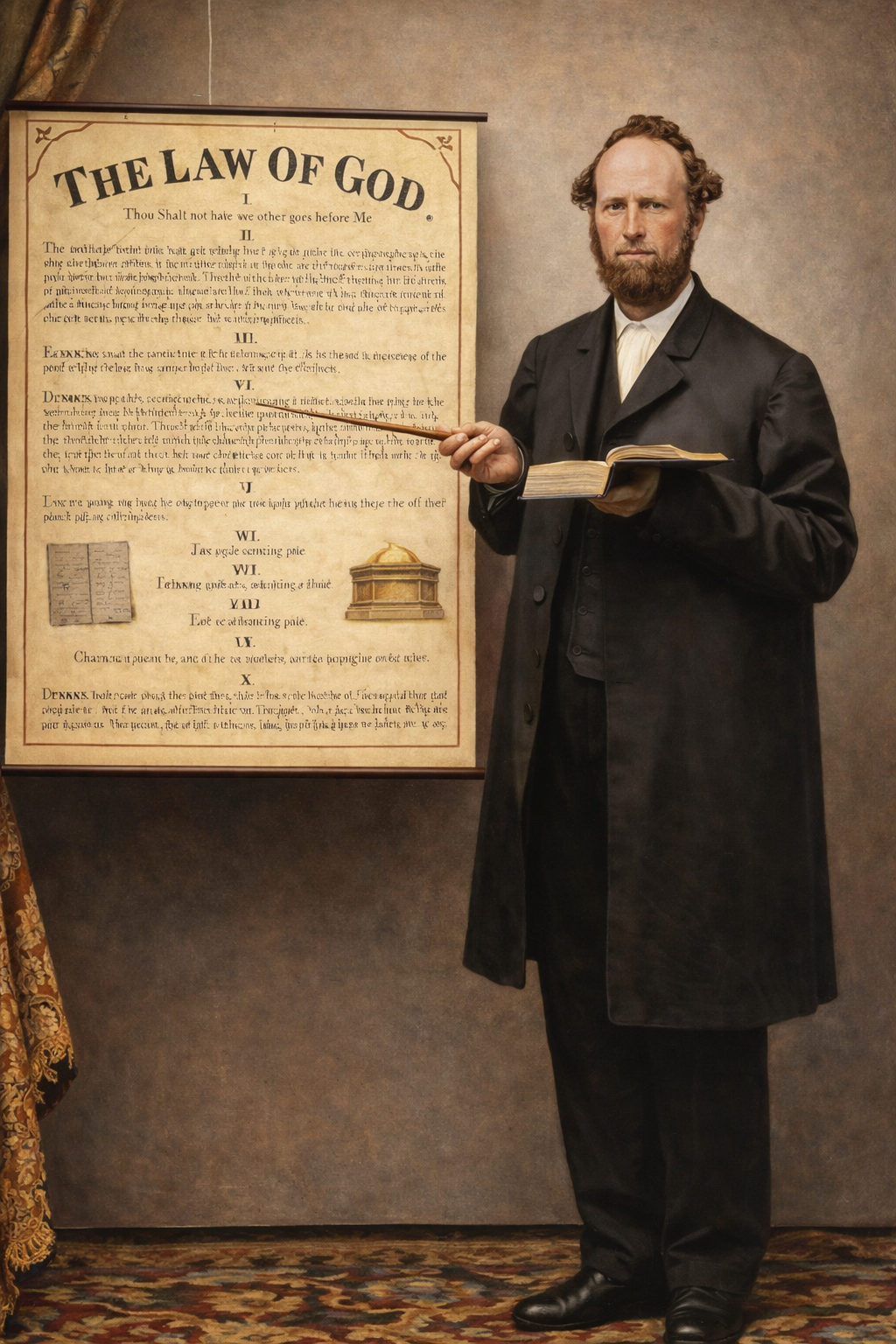
James White is often described as if he were only the efficient half of a famous marriage, the practical man standing beside the prophet. That leaves the picture too thin.
He was one of the central makers of early Sabbatarian Adventism in his own right: preacher, publisher, organizer, editor, institutional builder, and a man whose strength lay not in mystery but in motion.
When others saw a burden, James usually saw a task that had to be carried.
The Boy Who Was Not Expected To Become This Man
James Springer White was born in Palmyra, Maine, in 1821, the fifth of nine children. His early life did not promise public leadership.
Accounts of his youth describe a sickly boy troubled by seizures and impaired eyesight, with little access to formal education and every reason to expect a small rural life.
Then, as a teenager, his sight improved. The world widened almost at once. He entered academy study, earned a teaching certificate, and briefly taught school.
That detail matters because James White never entirely lost the habits of a self-made man.
Even when he became an Advent preacher, he retained the drive of someone who had already fought his way out of physical limitation.
He did not move through life as if opportunity had been laid at his feet. He moved as if everything useful had to be wrestled into existence.
From Schoolroom To Advent Preaching
After hearing Advent preaching in Exeter, Maine, White abandoned the safer path of teaching and entered the ministry through the Christian Connexion. He was ordained in 1843 and quickly developed a reputation as a forceful preacher.
Contemporary accounts say that in the winter of 1843 roughly a thousand people accepted the Millerite message through his labors.
That kind of number is not just a statistic. It tells you how urgently he spoke, how directly he could seize a room, and how willing he was to spend himself for a cause he believed was pressing toward its final hour.
He also faced hostility. Reports survive of angry hearers hurling snowballs at him.
That image is almost too vivid to be improved upon: a young Advent preacher in winter Maine, speaking about the coming Christ while opponents answer with ridicule and ice.
James White kept preaching.
He Understood That Truth Needed A Press
After the disappointment of 1844, the Advent cause did not merely need comfort. It needed connection. Scattered believers had to be told what others were thinking, studying, praying, and concluding.
James White understood this early and with unusual clarity. In November 1848, at a small meeting of believers hosted by Otis Nichols and Mary Bird Nichols in Dorchester, Massachusetts — a meeting also attended by Captain Joseph Bates — Ellen White went into vision and received a direct charge for James: he was to begin publishing a paper. The vision described that it would be small at first, but that it would grow and grow until its light went clear around the world.
James White obeyed. In 1849 he launched The Present Truth — read the original: The Present Truth (PDF). In 1850 that paper joined with Advent Review to become the Second Advent Review and Sabbath Herald, the periodical that would shape the conversation of the developing movement for generations.
This is where James White becomes especially important. Some pioneers discovered; some testified; some persuaded. James created channels.
He saw that doctrine left only in meetings and memories would fray. Print gave the movement continuity. Print made debate portable. Print built identity across distance.
That may sound procedural until one remembers how fragile the Sabbatarian believers were in those years. Without publication, they may well have remained a set of regional fragments.
James White and Moses
A booklet preserved from the pioneer era draws a direct comparison between James White and Moses — the leader called to organize a people, carry impossible burdens, and channel divine direction into institutional reality. Like Moses, James White was not the visionary in the prophetic sense; he was the builder who made the vision workable.
Read the booklet: Modern Moses (PDF)
James White And Ellen White
James White met Ellen Harmon in the unsettled, searching years after the Millerite disappointment and married her on August 30, 1846.
The two were not simply husband and wife in private life and co-workers in public life. Those realities were fused.
James believed her visions were genuine, traveled with her among believers, published her writings, and helped create the institutional means by which her testimonies could travel far beyond any room in which she personally spoke.
It is tempting to write as if James was the machinery and Ellen the meaning. That is too neat.
He was deeply theological, deeply invested, and often personally burdened by the direction of the work.
But it is true that he gave form to things that otherwise might have remained local and fleeting. If Ellen White gave the movement one of its clearest voices, James White helped build the hearing apparatus.
The partnership also came at real cost. They buried children, endured criticism, traveled constantly, and carried responsibilities that would have strained far steadier domestic lives than theirs.
Their marriage was not ornamental to the story. It was one of the engines of the story.
The Builder Of Structure
James White's most enduring gift may have been his refusal to romanticize disorder. He understood that a movement opposed to dead formalism could still perish from formlessness.
In 1855 he moved the center of the work to Battle Creek, Michigan, helping create an identifiable operational hub. In 1863 he was one of the principal figures in the formal organization of the Seventh-day Adventist Church.
Later he served multiple terms as General Conference president and helped drive the publishing and educational work, including the development of Battle Creek College beginning in 1874.
He was not beloved because he was soft. He often pressed too hard, drove too fast, and expected much from those around him.
But history rarely gives durable institutions to people who are content with drift. James White's severity was often the shadow side of his sense of urgency.
The Stroke And The End
In 1865 he suffered a paralytic stroke, a blow that would have ended the public usefulness of many men.
He partially recovered and resumed labor, though never without cost.
The final years of his life were marked by recurring weakness and overwork, and in the summer of 1881 he was taken with fever and brought to the Battle Creek Sanitarium. He died there on August 6, 1881, two days after his sixtieth birthday.
His death did not remove a ceremonial founder. It removed one of the movement's chief load-bearers.
By then Adventism possessed presses, periodicals, structures of governance, and widening educational ambition.
Those things did not arise automatically from doctrine. They were built, and James White was one of the men who built them.
Sources
- James S. White Wikipedia article, for baseline chronology on birth in Palmyra, early illness, improved eyesight, teaching, ordination, marriage, publishing work, stroke, and death.
- James S. White Wikipedia article, citing Richard W. Schwarz and Floyd Greenleaf, Light Bearers, for the report that about one thousand accepted the Millerite message through his preaching in 1843.
- James S. White Wikipedia article, for the history of The Present Truth and its merger into the Second Advent Review and Sabbath Herald.
- James S. White Wikipedia article, for his General Conference presidencies and role in Adventist institutional development.
- James S. White Wikipedia article, citing the Detroit Free Press obituary notice for his death in Battle Creek in August 1881.